



A registered nurse can spend years becoming the person everyone calls when a shift turns difficult. You may know how to calm an anxious family, catch a subtle change in a patient’s condition, manage a demanding assignment, and keep the unit moving when staffing is tight.
Then a promotion opens, and the application includes one small requirement that changes everything: BSN preferred or BSN required.
That moment explains why so many Texas nurses are returning to school without leaving the workforce. They are not questioning the value of their current nursing education. They are responding to a healthcare system that increasingly expects nurses to understand leadership, research, population health, care coordination, and quality improvement alongside bedside practice.
For working nurses, online education makes that step more realistic. It allows them to complete coursework around rotating shifts, family obligations, overtime, and the unpredictable rhythm of clinical work.
BSN Is Becoming a Career Mobility Credential
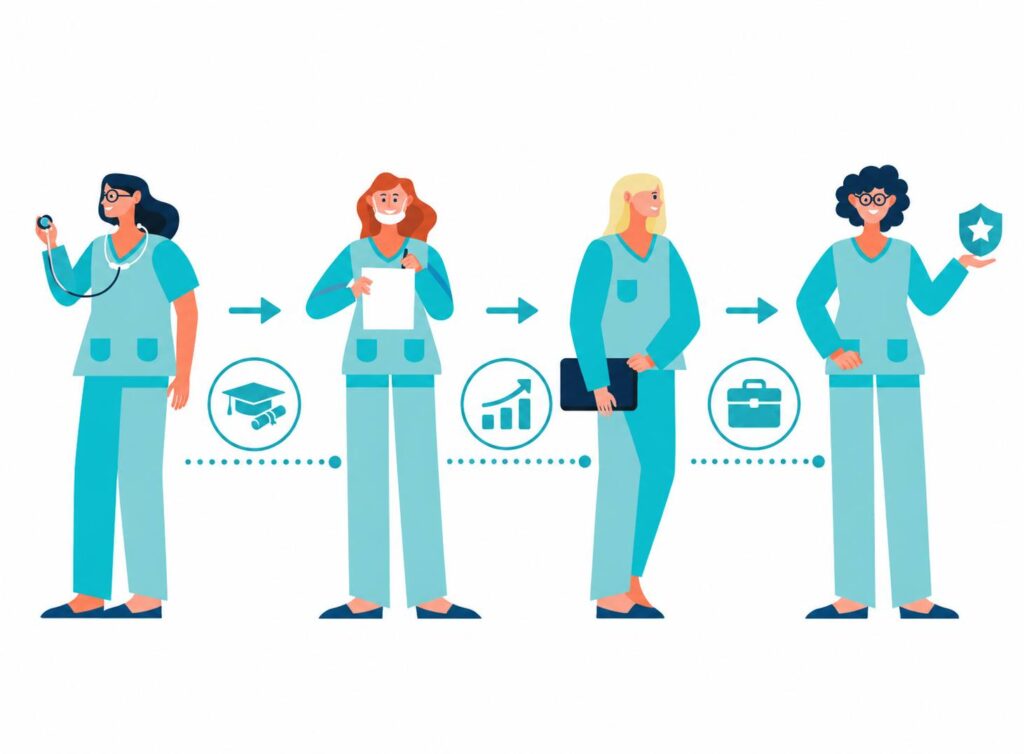
An associate degree in nursing can prepare someone to become a capable, licensed registered nurse. The clinical judgment developed through real patient care is not erased simply because another nurse holds a bachelor’s degree.
The difference often appears later in a nurse’s career.
A BSN may be preferred for positions involving staff supervision, case management, clinical education, public health, quality improvement, utilization review, infection prevention, research coordination, or administrative responsibility. It can also create a clearer path toward graduate nursing education.
The American Nurses Association’s RN-to-BSN guidance explains that these bridge programs are intended for nurses who already hold an active RN license and want to build on their previous education rather than repeat entry-level nursing training.
For many Texas nurses, the degree is less about proving they can perform bedside care and more about removing a credential barrier before it limits their next move.
The Famous 80 Percent Goal Needs Some Context
The push for a more highly educated nursing workforce did not begin with online universities or hospital recruitment departments.
In its influential 2011 report, the Institute of Medicine recommended increasing the proportion of registered nurses holding a bachelor’s degree to 80 percent by 2020. That target helped shape employer policies, academic partnerships, tuition-support programs, and conversations about nursing education across the country.
However, it should not be presented as a newly announced or completed target. The National Academies’ follow-up analysis of nursing education acknowledged that the profession did not reach the 80 percent goal by 2020. The broader direction remained important: nurses would need stronger preparation in leadership, public health, technology, health equity, and complex care systems.
That distinction matters. Texas nurses are not chasing an arbitrary number. They are responding to a long-term change in what healthcare organizations expect nurses to understand and contribute.
Why Hospitals Pay Attention to Nursing Education
A BSN does not automatically make one nurse more compassionate, careful, or clinically skilled than another. Experience, communication, judgment, staffing levels, teamwork, and workplace culture all affect patient care.
Still, nursing education can influence how prepared a nurse is to interpret research, participate in quality projects, assess community needs, coordinate care, and understand system-level risks.
The American Association of Colleges of Nursing’s review of education and nursing practice summarizes research associating higher proportions of BSN-prepared nurses with improved patient outcomes, including lower mortality and failure-to-rescue rates. These findings describe workforce patterns rather than guaranteeing how any individual nurse will perform.
Hospitals therefore have practical reasons to encourage degree completion. They need nurses who can do more than complete tasks correctly. They also need professionals who can examine why a process failed, evaluate evidence, communicate across departments, and help redesign care.
What Magnet Recognition Really Means for Nurses
Magnet recognition is often mentioned in conversations about BSN hiring, but the relationship is sometimes oversimplified.
The American Nurses Credentialing Center does not state that every bedside nurse in a Magnet-recognized hospital must hold a BSN. Its standards do, however, place substantial importance on nursing leadership, professional development, education, research, and measurable improvements in care.
The official Magnet educational eligibility criteria include specific graduate and nursing-degree expectations for senior nursing leadership positions. Individual hospitals may establish broader educational preferences as part of their workforce plans.
This is why an experienced associate-degree nurse may be highly valued in a current role but still encounter a degree requirement when applying for management, education, or system-level positions.
The BSN does not replace experience. It helps make that experience portable across a wider range of roles.
Why Online Study Fits the Reality of Nursing Work
A traditional campus schedule can be difficult for someone whose workweek may include nights, weekends, holidays, mandatory training, and last-minute staffing requests.
Online bridge programs address the scheduling problem by moving much of the academic work outside a fixed classroom. Many use asynchronous courses, meaning students complete readings, discussions, projects, and assignments within weekly deadlines rather than attending every lecture at a set hour.
That flexibility does not mean the work is effortless.
A discussion post may still be due after a difficult shift. A research assignment may compete with sleep, meal preparation, family responsibilities, and another stretch of scheduled work. The advantage is not that online education removes the workload. It gives the nurse more control over when that workload is completed.
For someone comparing an RN to BSN online Texas option, the most useful question is not simply, “How quickly can I graduate?” It is, “Can this program fit my actual work pattern without forcing me to sacrifice academic quality or personal health?”
What Nurses Actually Study in a Bridge Program
RN-to-BSN education should not feel like repeating basic nursing school. Students are already registered nurses, so the curriculum is generally designed to broaden how they understand care.
Common subjects include:
Evidence-Based Nursing Practice
Students learn how to locate research, evaluate its quality, and decide whether the findings should influence clinical practice.
This is different from being told that a policy is evidence based. Nurses learn to ask where the evidence came from, how strong it is, and whether it applies to their patient population.
Nursing Leadership
Leadership courses may cover delegation, conflict management, team communication, staffing, change management, ethics, budgeting, and organizational decision-making.
These skills are useful even for nurses who do not plan to become managers. Bedside nurses lead during emergencies, precept new staff, coordinate care, and influence unit culture every day.
Community and Population Health
Hospital nursing often focuses on the problem directly in front of the clinician. Community health asks why certain problems repeatedly appear in particular families, neighbourhoods, or patient groups.
Students may examine access to care, chronic disease, health literacy, environmental risks, prevention, and the social conditions that affect recovery.
Quality and Patient Safety
Nurses study how medication errors, communication failures, readmissions, infections, falls, and delays in care can be examined at a system level.
The focus moves away from blaming one person and toward understanding how workflows, technology, policies, staffing, and communication contributed to the event.
Healthcare Policy and Informatics
Modern nursing involves electronic records, data reporting, privacy requirements, clinical technology, reimbursement rules, and organisational policies.
A BSN program introduces nurses to the systems surrounding the bedside so they can take part in decisions rather than simply receive instructions after those decisions have been made.
An Online Format Still Requires Real Discipline
The phrase “study at your own pace” can create the wrong impression. Most online nursing programs still have weekly deadlines, group discussions, graded projects, examinations, and participation expectations.
The nurses who manage these programs successfully often build their study schedule around energy rather than free time alone.
For example, a nurse may avoid placing difficult research work immediately after the third consecutive night shift. That period may be better used for a short discussion response, recorded lecture, or reading assignment. Larger projects can be reserved for a protected day when concentration is more reliable.
Practical habits include:
- Reviewing the entire course calendar before the first busy workweek
- Starting written assignments before scheduled shifts
- Keeping one recovery period free from work and school
- Informing family members about major academic deadlines
- Using employer education benefits before paying personally
- Asking instructors for clarification early rather than near the deadline
Flexibility works best when a routine supports it.
Texas Nurses Should Verify More Than the School’s Marketing
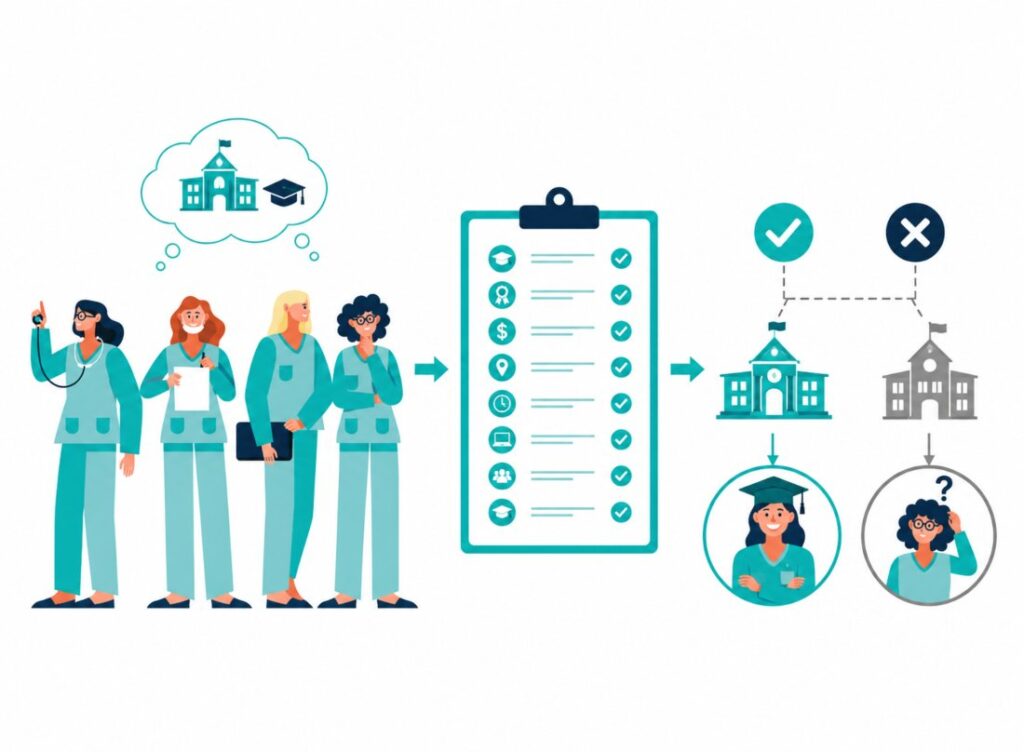
Choosing a bridge program requires more than comparing tuition figures and graduation timelines.
The Texas Board of Nursing explains that post-licensure RN-to-BSN programs are treated differently from pre-licensure nursing programs because enrolled students are already registered nurses. The board does not approve these programs in the same way it approves programs that prepare students for initial RN licensure. Nurses can read the Texas Board of Nursing explanation of post-licensure education before assuming that “Texas approved” is the only quality check that matters.
A careful comparison should include both institutional accreditation and nursing-program accreditation.
The Commission on Collegiate Nursing Education database allows prospective students to check whether a baccalaureate nursing program currently holds CCNE accreditation. The U.S. Secretary of Education recognizes CCNE as a national nursing accreditation agency.
Students can also use the U.S. Department of Education accreditation database to verify information reported by recognized accrediting organizations.
Before applying, ask the school:
- How many previous nursing and general education credits will transfer?
- Are there additional technology, graduation, or assessment fees?
- Does the program require practicum, community, or workplace-based projects?
- Can those requirements be completed near the student’s home?
- Are courses offered continuously or only during certain terms?
- What happens when a nurse needs to pause for work or family reasons?
- Does the student’s current employer recognize the program?
- Will the degree satisfy admission requirements for future graduate study?
These questions reveal more than an advertisement promising a fast completion time.
Tuition Should Be Calculated After the Transcript Review
A low price per credit hour can be appealing, but it may not represent the student’s final cost.
One nurse may transfer nearly every general education requirement and need only upper-level nursing courses. Another may need statistics, government, history, science, or elective credits before graduating. Two students entering the same program can therefore receive very different cost estimates.
A useful calculation should include:
- Remaining nursing credits
- Outstanding general education credits
- Application and graduation fees
- Books or digital course materials
- Technology and online-learning fees
- Transcript evaluation costs
- Possible practicum-related expenses
- Employer tuition reimbursement
- Scholarships or institutional grants
Pay-as-you-go terms can reduce the need to borrow, but students should confirm whether spreading courses across more terms creates additional fees.
A written degree plan based on an official transcript evaluation is far more useful than a tuition estimate shown on a general landing page.
Be Careful With NCLEX Pass Rates
NCLEX results are highly relevant when evaluating a pre-licensure nursing program. They show how successfully a program prepares students who are attempting to become licensed registered nurses.
An RN-to-BSN student is different. The nurse has already passed the NCLEX and already holds an RN license.
For that reason, an undergraduate school’s NCLEX pass rate may say little about the quality or suitability of its post-licensure bridge track. RN-to-BSN applicants should pay closer attention to completion rates, student retention, faculty support, accreditation, transfer policies, course availability, graduate-school acceptance, and employer recognition.
The school should be evaluated for the program the nurse will actually attend, not a different program operating under the same university name.
BSN Can Widen the Career Map
A BSN does not guarantee a promotion or immediate salary increase. Compensation depends on the employer, location, specialty, experience, shift, certifications, and local labour conditions.
It can, however, make a nurse eligible for opportunities that would otherwise remain closed.
The U.S. Bureau of Labor Statistics overview of registered nursing notes that nurses work across hospitals, outpatient settings, home healthcare, schools, government organisations, and other care environments. It also projects continued national demand for registered nurses through 2034.
For a Texas nurse, the value of a BSN may appear in several ways:
- Eligibility for clinical leadership positions
- A stronger application for specialty or competitive hospital units
- Access to quality, safety, education, and care-coordination roles
- Preparation for public or community health nursing
- A clearer route into an MSN, DNP, or other graduate program
- Greater flexibility when changing employers
- Protection against future changes in hiring requirements
The degree is most valuable when it supports a specific direction. A nurse who wants to move into education will evaluate a program differently from someone planning to enter informatics, management, public health, or advanced practice.
Going Back to School Does Not Mean Leaving Bedside Nursing Behind
Some experienced nurses hesitate to pursue a BSN because they worry that academic education will undervalue practical knowledge.
A strong bridge program should do the opposite.
It should give language and structure to what nurses already notice during real shifts. Why do the same discharge problems keep happening? Why does one communication method reduce errors while another creates confusion? Why are certain patient groups returning to the hospital? Why does a policy look sensible on paper but fail during a busy night?
Bedside experience provides the questions. Bachelor’s-level coursework provides additional tools for investigating them.
That is why Texas nurses are spending more time in front of laptops after spending their shifts in scrubs. They are not stepping away from nursing. They are making sure their education reflects the level of responsibility they already carry and the career options they want to have next.