When I first started planning trips to expensive American cities like New York, San Francisco, and Boston, I nearly gave up. The hotel prices alone made my eyes water, and I couldn’t imagine how I’d afford food, attractions, and transportation on top of that. But then I discovered that with the right budget travel tips, expensive cities in the USA become accessible even for travellers watching every dollar. Let me share everything I learned about experiencing America’s priciest destinations without emptying your bank account.
Finding Affordable Places to Stay
Accommodation usually eats up the biggest chunk of any travel budget, especially in expensive American cities. I’ve tried every type of lodging option imaginable, and I’ve learned that where you sleep doesn’t have to cost a fortune if you’re willing to think creatively.
On my first trip to New York City, I made the mistake of booking a hotel in Times Square, thinking I wanted to be in the centre of everything. That tiny room with a view of a brick wall cost me 250 dollars per night. I could barely afford to eat after paying for three nights there. Now I know better, and I’ve developed strategies that are essential budget travel tips for visitors to expensive cities in the USA.
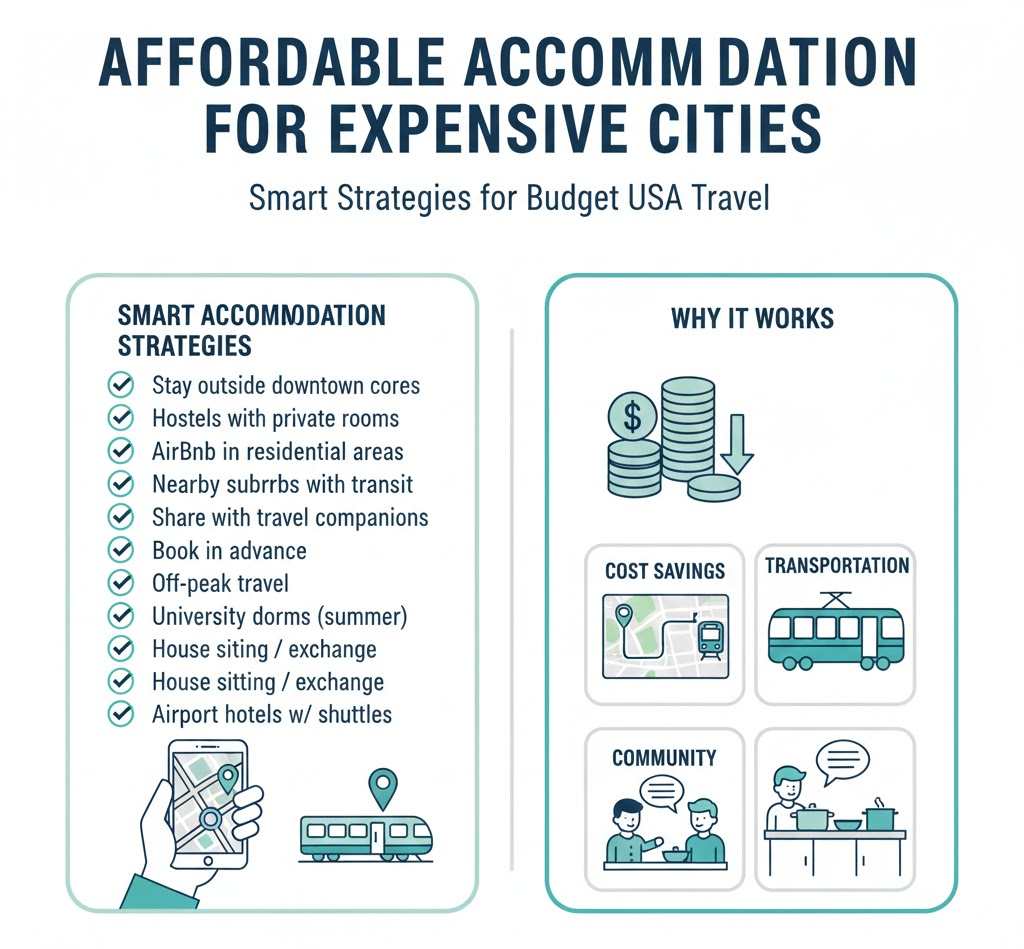
Smart accommodation strategies:
- Stay in neighbourhoods outside downtown cores
- Book hostels with private rooms for comfort
- Use Airbnb in residential neighbourhoods
- Consider staying in nearby suburbs with transit access
- Share accommodations with travel companions
- Book months in advance for better rates
- Travel during off-peak seasons when possible
- Use hotel points or credit card rewards
- Check university dorms during summer breaks
- Try house sitting or home exchange services
- Stay further out and commute in daily
- Look for hotels near the airport with free shuttles
The key realisation that changed my travel was understanding that expensive cities have excellent public transportation. You don’t need to stay in the most central location, since you can easily get to anywhere within 30 to 45 minutes. In San Francisco, I stayed in the Sunset District, near Golden Gate Park, rather than downtown. My Airbnb cost 80 dollars per night instead of 200 plus, and I was on the metro line that took me downtown in 25 minutes.
Hostels aren’t just for college kids anymore. I’m in my thirties, and I’ve stayed in hostels that were clean, comfortable, and full of travellers of all ages. Many hostels now offer private rooms with en-suite bathrooms for half the price hotels charge. In Boston, I found a hostel in Cambridge near Harvard that had a private room for 75 dollars per night, included breakfast, and had a kitchen where I could prepare other meals.
The hostel’s common areas became unexpected benefits. I met other travellers, got restaurant recommendations from people who’d been exploring longer than I had, and even found companions for day trips. One couple I met at a Seattle hostel had a car and invited me to join them for a drive to Mount Rainier, splitting the gas cost three ways and turning an expensive excursion into an affordable adventure.
Staying in the suburbs requires research to ensure good public transit access. When visiting Washington, DC, I stayed in Arlington, Virginia, just across the river. My hotel was a 15-minute metro ride from the National Mall, cost 90 dollars per night instead of 200 plus in the city, and the neighbourhood had affordable restaurants where locals actually ate.
Getting Around Without Spending a Fortune
Transportation costs add up quickly in expensive cities, but these budget travel tips for USA travellers can keep you mobile without breaking the bank. Owning or renting a car in most major American cities is actually a disadvantage, not a benefit.
My biggest transportation mistake was renting a car for a week in San Francisco. Between the rental cost, insurance, gas, and parking fees that reached 40 dollars per day, I spent over 600 dollars. Meanwhile, unlimited weekly public transit passes cost around 25 dollars. I learned this lesson the expensive way, so you don’t have to.
Cost-effective transportation methods:
- Buy multi-day public transit passes immediately
- Walk whenever distance allows
- Download city transit apps for routes and timing
- Use bike share programs for short trips
- Take advantage of free shuttle services
- Uber or Lyft only when splitting costs
- Avoid taxis, which cost more than rideshares
- Many cities have free trolleys or buses in tourist areas
- Walk across bridges for amazing views
- Transit passes often include buses, trains, and ferries
- Student discounts available with a valid ID
- Senior rates for travellers over 65
Public transportation in expensive American cities is generally excellent. New York’s subway system can get you anywhere in the city for a flat fare. Chicago’s L train connects all neighbourhoods. Boston’s T system is comprehensive. San Francisco’s BART and Muni cover the entire Bay Area. These systems exist because locals use them daily, and they work well for tourists too.
I now buy a multi-day transit pass as soon as I arrive in any city. In Seattle, the three-day pass cost 24 dollars, and I used it constantly, riding buses to Pike Place Market, taking the light rail to the airport, and exploring different neighbourhoods without worrying about individual fares adding up. The unlimited nature of these passes encourages exploration because every trip feels free once you’ve paid for the pass.
Walking is underrated as both transportation and sightseeing. Some of my best travel memories come from walking through neighbourhoods rather than rushing past in vehicles. In Chicago, I walked along the lakefront from Navy Pier down to the Museum Campus, about three miles. The walk was beautiful, I saw neighbourhoods I wouldn’t have otherwise visited, and I saved money while getting exercise.
Bike-sharing programs now exist in most of the most expensive American cities. You’ll see rows of bikes at docking stations throughout urban areas. These programs typically charge by the trip, with the first 30 or 45 minutes free or very cheap. I used Citi Bikes constantly in New York, hopping from dock to dock as I explored different neighbourhoods. A day pass costs 15 dollars for unlimited 45-minute rides, much cheaper than other transportation and more flexible than walking long distances.
Eating Well on a Tight Budget
Food is where many travellers overspend in expensive cities, but it’s also where smart budget travel tips can make the biggest difference in the USA. You absolutely don’t need to eat at trendy restaurants or order delivery three times a day to experience a city’s food culture.
My eating habits on the road have evolved dramatically. Early trips, I’d eat every meal at restaurants and wonder why I ran out of money so quickly. Now I’ve developed a system that lets me enjoy local food while keeping costs reasonable. In expensive cities, restaurant meals can cost 20 to 40 dollars per person before drinks and tips, meaning three meals a day would cost 60 to 120 dollars for one person.
Budget-friendly eating strategies:
- Stay places with kitchen access when possible
- Shop at grocery stores for breakfast and snacks
- Make your own coffee instead of buying it daily
- Eat your main meal at lunch when prices are lower
- Look for happy hour food specials
- Food trucks are often cheaper than restaurants
- Ethnic neighbourhoods have affordable, authentic food
- Takeout costs less than dining in with tips
- Share large portions with travel companions
- Drink water instead of sodas or alcohol
- Picnic in parks with grocery store supplies
- Save restaurant meals for special occasions
I’ve developed a routine that works in any city. I shop at a grocery store soon after arriving and stock up on breakfast items, snacks, and ingredients for simple meals. Greek yoghurt, granola, fruit, bread, peanut butter, and cheese have become my staples. Making breakfast at my accommodation instead of eating out saves 10 to 15 dollars a day. That’s 70 to 100 dollars per week staying in my pocket.
Coffee is another area where savings accumulate. A coffee shop latte costs $5 to $7 in expensive cities. Buying that twice daily is 10 to 14 dollars, or 70 to 100 dollars per week. I bring a small French press when I travel or use whatever coffee maker is available. Grocery store coffee costs 10 dollars and lasts the entire trip. This one change alone saves substantial money.
Lunch specials are one of the best budget travel tips that USA residents actually use in expensive cities. Many expensive restaurants that offer dinner portions charge half price for lunch portions of the same food. In San Francisco, I ate lunch at a highly-rated Japanese restaurant where dinner entrees cost 35 to 50 dollars, but the lunch bento boxes with similar food cost 16 dollars.
Food trucks and food halls have become my favourite places to eat in expensive cities. These offer high-quality food at reasonable prices in casual settings. In Portland, the food truck pods have an incredible variety, with meals costing 8 to 12 dollars. Los Angeles food trucks serve amazing tacos, Korean barbecue, and fusion food for similar prices. The TimeOut Market locations in several cities bring together multiple vendors in one space.
Ethnic neighbourhoods are gold mines for affordable, authentic food. In New York, I’d take the subway to Queens neighbourhoods like Flushing or Jackson Heights, where I could eat incredible Chinese, Indian, or Latin American food for 8 to 12 dollars, a fraction of what similar-quality food costs in Manhattan. San Francisco’s Mission District has fantastic taquerias. Boston’s Chinatown offers affordable dim sum. These neighbourhoods welcome curious visitors and offer glimpses into the diverse communities that make American cities interesting.
I’ve also learned that picnicking is underrated. On nice days, I’ll buy sandwich ingredients, fruit, and snacks at a grocery store, then eat in a park or public space. In Chicago, I made sandwiches and ate them in Millennium Park, watching people take photos of the Bean sculpture. In Seattle, I picnicked at Gas Works Park with a view of the city skyline. These meals cost 7 to 10 dollars, provided pleasant experiences, and felt more memorable than sitting in another restaurant.
Free and Cheap Attractions
One of the most important budget travel tips for tourists visiting the USA is that many of the best experiences cost little or nothing. I’ve spent countless hours enjoying free attractions in expensive cities, often having better experiences than at pricey tourist traps.
Washington, DC, stands out as incredibly budget-friendly despite being an expensive city. Almost all the Smithsonian museums are completely free. The National Mall, monuments, and memorials cost nothing to visit. I spent an entire week in DC and barely spent money on attractions because there was so much free culture and history available.
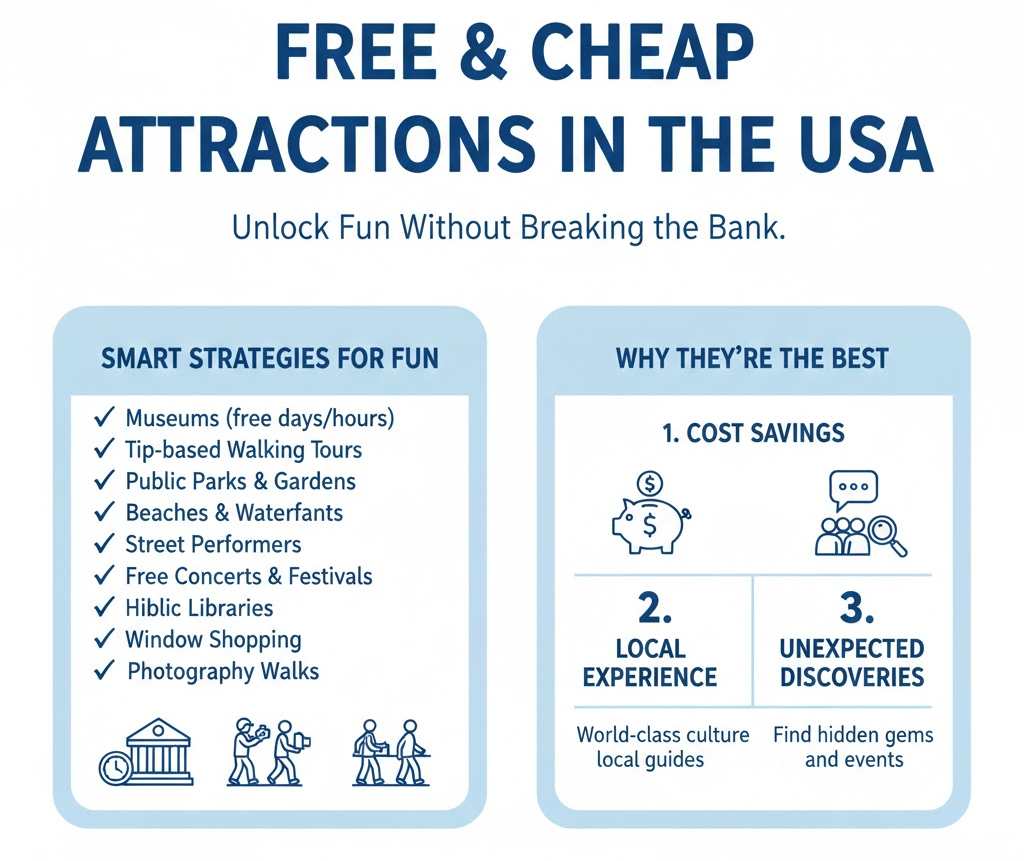
Free and low-cost activities:
- Museums with free admission days or hours
- Walking tours with tip-based guides
- Public parks and gardens
- Beaches and waterfront areas
- Historic neighbourhoods for wandering
- Street performers and public art
- Free concerts and festivals during the summer
- University campuses worth exploring
- Public libraries with beautiful architecture
- Hiking trails near cities
- Window shopping in interesting neighborhoods
- Photography walks to capture the city’s character
Almost every expensive American city has museums with free admission times. I plan my itineraries around these opportunities. In San Francisco, many museums are free on the first Tuesday of each month. In Boston, the Institute of Contemporary Art is free on Thursday evenings. New York’s Museum of Natural History operates on a suggested donation system, meaning you can pay what you wish rather than the full admission price.
I’ve learned to check museum websites for free days before paying full admission. There’s usually one free option weekly if you’re flexible with timing. This approach has let me visit world-class museums in expensive cities without museum costs decimating my budget.
Free walking tours are among my favourite activities. Many cities offer tip-based walking tours where knowledgeable guides show you neighbourhoods and share their history. You pay what you think the tour was worth at the end. I usually tip 10 to 20 dollars for a two- to three-hour tour, much less than the paid tours charging 40 to 60 dollars, and the guides are often more passionate and knowledgeable because they rely on tips from satisfied customers.
In Chicago, a free architecture walking tour took me through downtown, explaining the history of famous buildings. The guide was an architecture student with infectious enthusiasm. In New Orleans, a free cemetery and history tour taught me about the city’s unique burial practices and cultural heritage. These tours provided context and understanding that I wouldn’t have gained just walking around alone.
Parks are obvious free attractions, but often underutilised. Beyond just green space, many urban parks host free concerts, movie screenings, and festivals during warmer months. Central Park in New York, Griffith Park in Los Angeles, and Golden Gate Park in San Francisco are destinations in themselves. I’ve spent entire days in these parks, walking trails, visiting free museums or attractions within them, people-watching, and enjoying nature without spending money.
Beaches and waterfronts provide free entertainment in coastal cities. Santa Monica and Venice Beach in Los Angeles cost nothing but offer endless people-watching and beautiful ocean views. Miami’s South Beach is free to enjoy. San Diego’s coastline has multiple free beaches. I’d pack a lunch, bring a book, and spend half a day at the beach for zero cost beyond transportation to get there.
Shopping Smart for Souvenirs and Necessities
Shopping expenses sneak up on travellers in expensive cities. A souvenir here, a necessity you forgot there, and suddenly you’ve spent hundreds on things you didn’t plan for. These budget travel tips for expensive cities in the USA help shoppers control these creeping costs.
My souvenir philosophy has changed completely over the years of travel. Early trips, I’d buy t-shirts, magnets, and trinkets that seemed important at the time but now sit forgotten in drawers. Now I’m very selective about what I buy, focusing on items that truly evoke memories rather than generic tourist merchandise.
Smart shopping approaches:
- Skip tourist trap souvenir shops entirely
- Buy from local artists and makers instead
- Grocery stores for snacks are cheaper than convenience stores
- Drugstore chains for toiletries and necessities
- Outlet malls in the suburbs for clothing deals
- Farmers’ markets for local food products
- Thrift stores for unique finds
- Museum gift shops for quality items
- Take photos instead of buying things
- Postcards cost less than larger souvenirs
- Local-made items over mass-produced trinkets
- Set souvenir budget before shopping
I now buy souvenirs from places like farmers’ markets, local craft fairs, or directly from artists. In Portland, I bought a small watercolour painting from an artist selling at Saturday Market for 30 dollars. That painting hangs in my living room and reminds me of my trip every day. It’s more meaningful than a dozen cheap t-shirts or magnets would have been, and supporting a local artist feels better than enriching a corporate tourist shop.
For necessities I forgot to pack, drugstore chains like CVS, Walgreens, or Rite Aid offer better prices than hotel gift shops or tourist-area convenience stores. When I realised I’d forgotten sunscreen in Miami, the CVS had it for 8 dollars versus 18 dollars at the beachfront convenience store. These savings matter when you’re budget travelling.
I’ve also learned that expensive cities often have great thrift stores and vintage shops where you can find unique items for cheap. In San Francisco, I found amazing vintage clothing in Haight-Ashbury thrift stores. Seattle has incredible used bookstores where I bought local author books for a few dollars each. These shops offer more interesting shopping than mall chain stores and fit better with budget travel goals.
Timing Your Visit Strategically
When you visit expensive American cities, it matters a great deal for your budget. This is one of the most impactful budget travel tips for USA travellers in expensive cities, yet many people don’t consider timing beyond their vacation schedule.
I’ve visited some cities during peak season and off-peak season, and the cost difference is staggering. New York during the Christmas season is magical, but hotel rooms cost double or triple their normal rate. Visiting in January or February, you’ll find rooms for half the price, and the city is equally interesting without holiday crowds.
Timing strategies that save money:
- Visit during shoulder seasons before and after peak times
- Weekdays are often cheaper than weekends for hotels
- Winter rates are much lower in most cities
- Summer is crowded and expensive in popular destinations
- Check local event calendars before booking
- Avoid major conventions that spike hotel prices
- Hotel rates drop during holidays when business travel stops
- Book flights on Tuesdays and Wednesdays
- Last-minute deals are sometimes available
- Extended stays may offer weekly rate discounts
San Francisco demonstrates this principle perfectly. Summer is the peak tourist season, with hotel rates at their highest, and fog often rolls in, making the weather less pleasant than expected. Fall has better weather, fewer tourists, and lower prices. I visited in October and had beautiful, sunny weather, smaller crowds at attractions, and paid 40 per cent less for my hotel than summer rates would have been.
Checking for major events and conventions before booking saves money and headaches. Cities host conventions that fill hotels and spike prices during specific weeks. I almost booked a trip to Seattle for the same week as a massive tech conference. Hotel rooms were at triple the normal rate and mostly sold out. I shifted my trip by 1 week, found abundant availability, and paid the normal rates.
Weekday versus weekend timing matters too, especially for business-focused cities. Hotels in cities like New York, Chicago, or Boston cater to business travellers during the week and often offer lower weekend rates. Conversely, tourist destinations might be cheaper midweek. Understanding a city’s primary visitor type helps you time your visit for better rates.
Winter is the ultimate budget travel season for the most expensive American cities. Yes, the weather is colder and the days are shorter, but savings can be dramatic. Chicago hotels that cost 300 dollars per night in summer might be 120 dollars in January. Most attractions remain open year-round. You need to bundle up and embrace the cold. I’ve had wonderful winter trips to Boston, New York, and Seattle when my budget couldn’t have afforded summer rates.
Making the Most of Free WiFi and Technology
Technology provides numerous budget travel tips for visitors to the USA. Your smartphone becomes an invaluable money-saving tool when used strategically.
I rely heavily on apps and online resources to find deals, navigate without data charges, and access information without paying for tourist materials. Before smartphones, budget travel was harder because finding information required buying guidebooks or asking locals. Now, enormous amounts of helpful information sit in your pocket.
Technology tools that save money:
- Download offline maps before arrival
- Free WiFi at cafes, libraries, and public spaces
- Apps for transit directions and schedules
- Restaurant apps for deals and reservations
- Hotel apps with exclusive discounts
- Flight deal apps for cheap tickets
- Grocery delivery apps to avoid expensive takeout
- Podcast walking tours instead of paid guides
- Social media for current event information
- Weather apps to plan activities
- Currency converters if visiting from abroad
- Photo storage to avoid buying cheap cameras
Downloading offline maps before arriving in a city eliminates the need for data roaming charges or constantly searching for WiFi. Google Maps lets you download entire city maps to your phone. Then you can navigate, search for addresses, and find directions without any data connection. This saved me countless times when I didn’t have WiFi and needed directions.
I’ve learned which chain businesses reliably offer free WiFi. Starbucks, McDonald’s, and most public libraries have free internet access. Many cities provide free public WiFi in parks and downtown areas. I’d start my day at a cafe with free WiFi, check my email, look up attraction hours and addresses, download any information I needed, and then be prepared for the day without needing data.
Apps like HappyHour, Yelp, and local restaurant week apps show current food and drink deals throughout cities. In San Francisco, I used an app that listed every happy-hour special in the city, then planned my afternoon around places with good deals when happy hour started. This let me enjoy the restaurant scene in an expensive city without paying full dinner prices.
Several podcasts offer free audio walking tours of major cities. You download the files before your trip, then play them as you walk through neighbourhoods. These provide narration and historical context just like paid audio tours, but completely free. I used one in Boston that guided me along the Freedom Trail, explaining the Revolutionary War history of each site.
Building a Realistic Daily Budget
Creating an actual budget before your trip is essential. Too many people skip this step and hope their money lasts. I’ve learned to calculate a realistic daily budget using these budget travel tips, for even in expensivin the USA,n the USA,travellersellers with limited funds.
My budgeting process starts with researching the specific city I’m visiting. Costs vary significantly between expensive American cities. New York and San Francisco are among the most expensive. Cities like Seattle, Boston, and Washington, D.C. are expensive but slightly less so. Understanding what things actually cost in your destination lets you build an accurate budget.
Daily budget categories:
- Accommodation divided by the number of nights
- Transportation, either daily fares or pass costs
- Food for three meals plus snacks and drinks
- Attraction admission fees or activity costs
- Shopping and souvenir money, if any
- Emergency buffer for unexpected expenses
- Entertainment, like bars or nightlife
- Tips for services throughout the day
For a budget trip to an expensive American city, my daily spending typically breaks down like this: Accommodation: 60 to 80 dollars per night, using hostels or budget hotels outside city centres. Transportation: $5 to 10 dollars per day or a prepaid weekly pass. Food costs 30 to 40 dollars, with grocery-store breakfasts, affordable lunches, and mid-range dinners. Attractions cost 10 to 20 dollars, taking advantage of free options when possible. That’s roughly $105 to $150 daily for a comfortable budget trip to expensive cities.
I always add a 20 per centper cent buffer for unexpected costs, because something always comes up. It may rain, and you need to Uber instead of walking. You may find an attraction you really want to visit that wasn’t in your original plan. Having this buffer prevents budget stress and allows some spontaneity.
Tracking spending as you go helps you stay within budget. I use a simple notes app on my phone where I jot down every expense. At the end of each day, I total my spending and compare it to my budget. This awareness prevents overspending early in a trip that would force me to skimp later. If I’m under budget one day, I can splurge the next day slightly without guilt.
Why Budget Travel Makes Trips Better
After years of budget travelling through expensive American cities, financial constraints actually improved my travel experiences rather than limiting them. These budget travel tips for expensive cities in the USA USA taught me to travel more thoughtfully and engage more deeply with the places I visited.
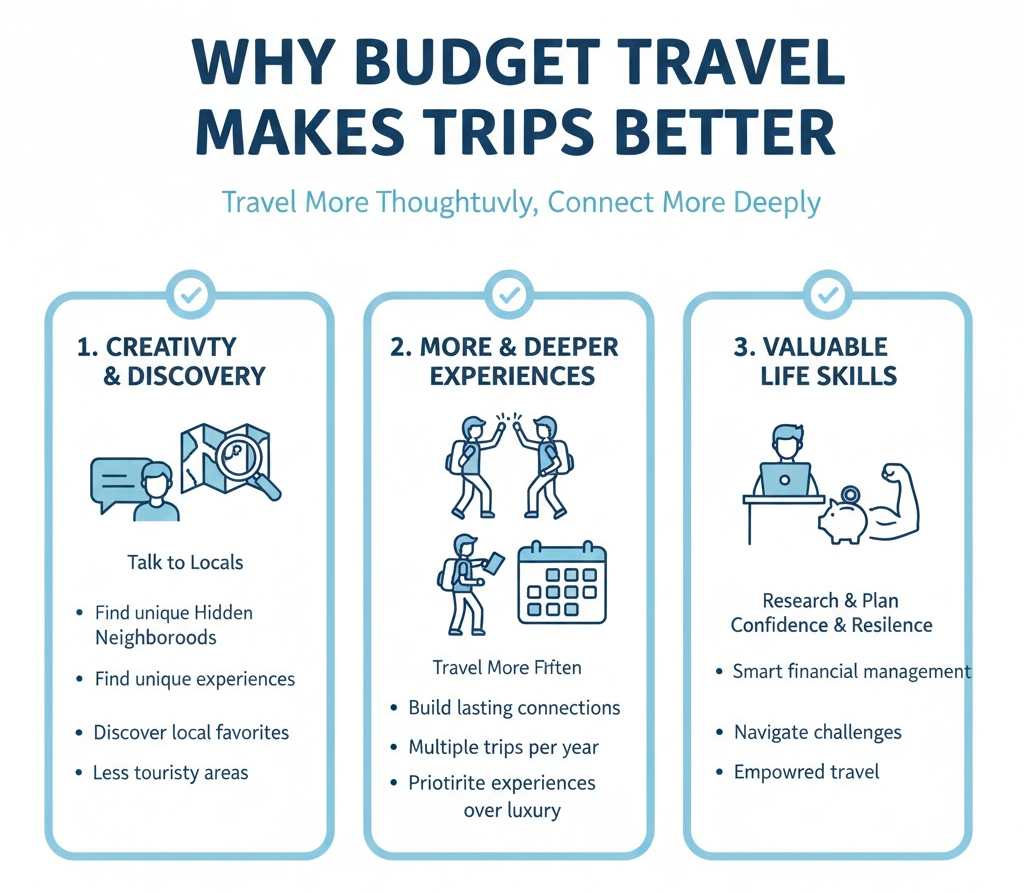
When you can’t just throw money at every problem or desire, you’re forced to be creative. You talk to locals asking for recommendations instead of reading expensive guidebooks. You explore neighbourhoods where real people live, not just tourist zones. You discover hole-in-the-wall restaurants locals love, rather than trendy spots promoted on Instagram.
Some of my best travel memories came from budget decisions that initially felt like compromises. Staying in hostels introduced me to travel friends I’m still in touch with years later. Taking long walks instead of taxis let me stumble upon neighbourhoods and sights I would have otherwise missed. Cooking meals in shared kitchens led to conversations with people from around the world.
Budget travel also means I can travel more often. By keeping costs down on individual trips, I can afford multiple trips per year instead of one expensive vacation. I’d rather visit three cities, spending 600 dollars each, than one city, spending 1800 dollars. More experiences matter more to me than luxury experiences.
The skills you develop through budget travel serve you well beyond tourism. Learning to research, plan, find deals, and live within constraints are valuable life skills. The confidence that comes from successfully navigating expensive cities on limited budgets carries over into other challenging situations.
These budget travel tips for expensive cities in the USA aren’t about deprivation or missing out. They’re about being intentional with money so you can afford the experiences that matter while skipping things that don’t add real value. A fancy hotel room is nice, but you spend most of your time out exploring anyway. An expensive meal can be great, but food trucks and ethnic restaurants often taste just as good and feel more authentic.
If you’ve been avoiding expensive American cities because you thought you couldn’t afford them, I hope these strategies show you that budget travel makes these destinations accessible. With planning, flexibility, and smart choices, you can explore New York, San Francisco, Boston, Seattle, Chicago, and other expensive cities without going into debt or emptying your savings account.
Start planning your trip, research your specific destination, calculate a realistic budget, and then experience these amazing cities. The memories you’ll create are worth far more than the money you’ll spend, especially when you keep that spending reasonable through smart budget travel decisions.