
When I first arrived in Lisbon, I wasn’t prepared for how much this city would move me. The golden light bouncing off yellow trams climbing steep hills, the sound of fado music drifting from tiny restaurants, and the smell of fresh pastéis de nata from every corner bakery created an atmosphere that felt both ancient and alive. Let me share everything I discovered about things to do in Lisbon so you can fall in love with this city just like I did.
Exploring the Historic Neighbourhoods
Lisbon is best experienced by wandering through its distinct neighbourhoods, each with its own personality and charm. I quickly learned that the magic of Lisbon lies not in rushing from landmark to landmark, but in getting lost in its atmospheric districts.
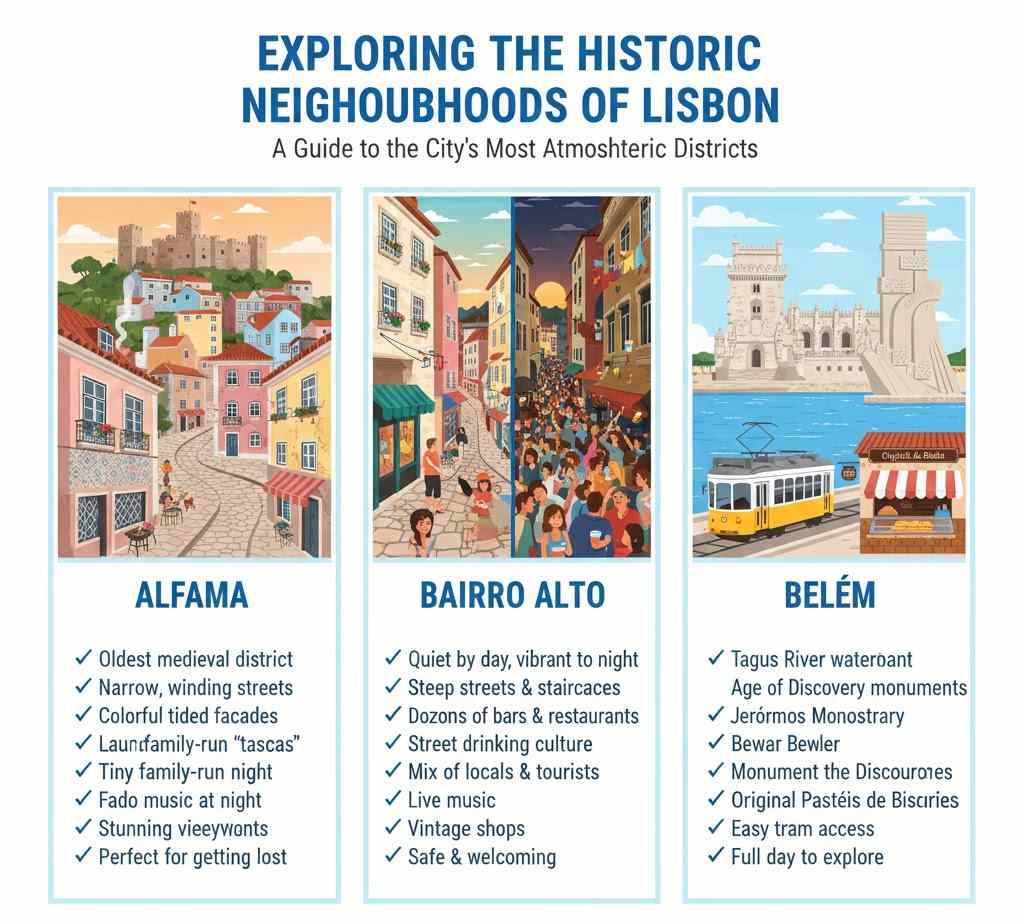
Alfama is the oldest neighbourhood in Lisbon and my absolute favourite place to explore. This medieval district survived the devastating 1755 earthquake that destroyed much of the city, so walking through Alfama feels like stepping back in time. The narrow cobblestone streets wind up the hillside in a maze that’s impossible to navigate with a map. I gave up trying to follow directions and just wandered, which turned out to be the best decision.
What makes Alfama special:
- The oldest neighbourhood surviving from medieval times
- Narrow winding cobblestone streets
- Colourful tiles decorating building facades
- Laundry hanging between buildings overhead
- Tiny family-run restaurants called tascas
- Fado music echoing from doorways at night
- Stunning viewpoints around every corner
- Castelo de São Jorge crowning the hilltop
- Residents still living authentically
- Less touristy than other areas
- Perfect for getting beautifully lost
- Street art mixing with historic architecture
I spent entire mornings just walking through Alfama with no particular destination in mind. Every turn revealed something beautiful or interesting. An elderly woman watering flowers on her balcony would wave and say, “Good morning.” A cat would saunter across my path and disappear into a hidden courtyard. The smell of grilled sardines would draw me toward a small restaurant where locals were having lunch.
The houses in Alfama are painted in faded yellows, pinks, and blues, decorated with traditional Portuguese tiles called azulejos. These tiles cover entire building facades in intricate patterns and pictures, turning ordinary buildings into works of art. I took a hundred photos of different tile designs I encountered.
Bairro Alto completely transforms between day and night. During the day, this neighbourhood is relatively quiet with small shops, art galleries, and cafes. The narrow streets are steep, and the buildings have the characteristic Lisbon look, with wrought-iron balconies and colourful facades. I’d walk through in the afternoon, popping into vintage clothing stores and bookshops, enjoying the relaxed atmosphere.
But when night falls, Bairro Alto becomes the heart of Lisbon’s nightlife. The streets fill with people, music pours from every bar and restaurant, and an infectious energy fills the air. Young locals and tourists mix, moving from bar to bar with plastic cups in hand since drinking in the streets is allowed here.
Bairro Alto characteristics:
- Quiet during the day, vibrant at night
- Steep, narrow streets and staircases
- Dozens of small bars and restaurants
- Street drinking culture at night
- Mix of locals and tourists
- Live music everywhere
- Vintage shops and galleries during the day
- Historic buildings with character
- Great sunset views from some streets
- Safe and welcoming atmosphere
- Walking is required as there are no cars fit
- Authentic neighbourhood feeling remains
I remember one evening, I joined a group of Portuguese university students I’d met at a bar. We spent hours moving from place to place, sampling different drinks and snacks, and talking about life, travel, and dreams. The openness and friendliness of people in Bairro Alto made it easy to make connections and have genuine conversations.
Belém, west of the city centre, sits along the Tagus River and represents Portugal’s Age of Discovery. This neighbourhood is where explorers like Vasco da Gama departed on their voyages to find new trade routes and distant lands. The monuments here celebrate that maritime heritage and Portugal’s historical importance.
I took the iconic yellow tram number 15 from downtown to Belém, which was an experience in itself. The tram rattles along tracks following the river, passing through neighbourhoods and offering glimpses of daily Lisbon life. The journey takes about 30 minutes and costs the same as any public transport ticket.
Belém neighbourhood highlights:
- Located along the Tagus River waterfront
- Historic monuments from the Age of Discovery
- Jerónimos Monastery with incredible architecture
- Belém Tower standing in the water
- Monument to the Discoveries celebrating explorers
- Original Pastéis de Belém bakery location
- Beautiful riverside parks and paths
- Museums, including art and carriages
- Less crowded than central neighbourhoods
- Easy tram access from downtown
- A full day is needed to explore properly
- Mix of history and river views
The Jerónimos Monastery took my breath away when I first saw it. This massive limestone building is a masterpiece of Manueline architecture, a Portuguese style that incorporates maritime elements and intricate stonework. I spent over an hour just walking around the monastery, admiring the detailed carvings of ropes, anchors, coral, and sea creatures worked into every surface.
Inside, the monastery is equally impressive. The cloisters feature two levels of arched walkways surrounding a peaceful courtyard. The stone carving is so delicate and detailed, it’s hard to believe it was done by hand centuries ago. The church section holds the tomb of Vasco da Gama, adding historical significance to architectural beauty.
Famous Yellow Trams and Viewpoints
One of the most iconic things to do in Lisbon is riding the vintage yellow trams that climb the city’s steep hills. These aren’t just tourist attractions but working public transportation that locals use daily. The trams are charming, practical, and offer unique ways to see the city.
Tram 28 is the most famous route and the most photographed tram in the world. This line winds through the historic heart of Lisbon, passing through the neighbourhoods of Graça, Alfama, Baixa, and Estrela. The route takes you past major sights while navigating impossibly narrow streets where the tram nearly brushes the buildings on both sides.
Riding Tram 28 experiences:
- The most famous tram route in Lisbon
- Passes through historic neighbourhoods
- Vintage wooden trams from decades ago
- Squeezes through narrow streets
- Steep climbs and descents
- Locals and tourists both use it
- It can get extremely crowded
- Pickpockets target this route
- Early morning rides are less busy
- The full route takes about 40 minutes
- Costs the same as regular public transport
- Hop on and off at various stops
I rode Tram 28 multiple times during my stay. My first ride was mid-morning, and the tram was absolutely packed. I stood squished between other passengers, holding on tight as the tram lurched around corners and climbed steep grades. While uncomfortable, something was exciting about the experience, hearing the tram squeal and rattle through streets barely wide enough to accommodate it.
My second ride was at 7 AM, and what a different experience. The tram was nearly empty, carrying mostly residents heading to work. I got a window seat and could actually see the neighbourhoods we passed through. The morning light made everything glow golden. I watched the city wake up, shopkeepers opening their stores, elderly residents walking to the market, and delivery trucks making their rounds.
The viewpoints scattered throughout Lisbon, called miradouros, offer some of the best free things to do in Lisbon. The city is built on seven hills, which means climbing is required, but the reward is spectacular panoramic views.
Best viewpoints I visited:
- Miradouro da Senhora do Monte has the highest views
- Miradouro da Graça with cafe and sunset crowds
- Miradouro de Santa Luzia with tiled decorations
- Miradouro das Portas do Sol overlooking Alfama
- Miradouro de São Pedro de Alcântara with two levels
- Santa Justa Lift for 360-degree city views
- Castelo de São Jorge for sweeping panoramas
- Each viewpoint offers a different perspective
- Most have benches or cafes nearby
- Popular spots for sunset watching
- Free to visit except the Santa Justa Lift
- Great for rest breaks while exploring
Miradouro da Senhora do Monte became my favourite spot for watching the sunset. Located in the Graça neighbourhood, this viewpoint offers the city’s highest public vantage point. I’d arrive about an hour before sunset and claim a spot on the low wall. Locals would gather with beers and snacks, tourists would set up cameras, and everyone would wait together for the show.
As the sun descended toward the horizon, the light turned everything golden, then pink, then deep orange. The red rooftops of Alfama glowed. The Tagus River reflected the colours. The São Jorge Castle stood silhouetted against the sky. In those moments, watching the sunset with strangers who’d become temporary friends, I felt completely present and grateful to be exactly where I was.
Experiencing Portuguese Food and Culture
Food is one of the most important things to do in Lisbon, and as someone who travelled to Portugal specifically for the culture, I left obsessed with the cuisine. Portuguese food is underrated internationally, but in Lisbon, you’ll eat some of the best meals of your life.
Pastéis de nata are the famous Portuguese custard tarts that you’ll see everywhere in Lisbon. These small pastries have a flaky, crispy exterior and a creamy custard filling that’s slightly caramelised on top. They’re best eaten warm, sprinkled with cinnamon and powdered sugar.
The original and most famous location is Pastéis de Belém, a bakery that’s been making these tarts since 1837 using a secret recipe. I waited in line for about 30 minutes to get into this place, and it was absolutely worth it.
Portuguese food experiences:
- Pastéis de nata from multiple bakeries
- Fresh grilled sardines are a traditional dish
- Bacalhau cod is prepared in hundreds of ways
- Seafood rice resembling paella
- Bifana pork sandwich as street food
- Francesinha for meat lovers
- Petiscos style of sharing small plates
- Fresh seafood from the Atlantic Ocean
- Regional cheeses and cured meats
- Caldo Verde Soup: Comfort Food
- Ginjinha cherry liqueur in chocolate cups
- Wine from nearby regions
Inside Pastéis de Belém, the bakery section is adorned with beautiful blue-and-white tiles. You can watch bakers working through windows, rolling dough and filling tart shells. I ordered six tarts to eat there and bought a box of six more to take away. The tarts were still warm, and that first bite was incredible. The custard was creamy and rich, but not too sweet, with a perfect caramelised top that added a slight bitterness to balance the sweetness.
I spent days eating my way through Lisbon, trying different restaurants and food markets. The Time Out Market in Cais do Sodré brings together some of Lisbon’s best chefs and restaurants under one roof. You can sample food from multiple vendors, try different Portuguese wines, and experience a range of flavours in a single visit.
One evening, I went to a traditional fado restaurant in Alfama. Fado is a type of Portuguese music characterised by mournful melodies and lyrics about fate, loss, and longing. The word fado comes from the Latin word for fate. Experiencing live fado music is essential among things to do in Lisbon.
Fado music experience details:
- Traditional Portuguese music genre
- Melancholic songs about fate and longing
- Usually performed in small restaurants
- Singer accompanied by a Portuguese guitar
- The audience is expected to be completely quiet
- Creates an emotional and intimate atmosphere
- Shows typically happen after 9 PM
- Dinner is included with the performance
- Reservations strongly recommended
- Both male and female singers
- Some venues are better than others
- Ask locals for authentic recommendations
The restaurant I chose was small and intimate, with twenty tables. We ate traditional Portuguese food while waiting for the performance to begin. Around 10 PM, the lights dimmed, and a woman stepped into the small performance space. She was accompanied by two musicians, one on a classical guitar and one on a distinctive Portuguese guitar with a teardrop shape.
When she began singing, the entire room fell silent. Her voice was powerful and emotional, filling the space with a sound that seemed to contain all the sadness and beauty of life. I didn’t understand the Portuguese words, but the emotion transcended language. Between songs, someone would translate the basic meaning, and many songs told stories of lost love, longing for home, or the hard lives of sailors and fishermen.
Historic Sites and Monuments
The historic monuments are among the most impressive things to do in Lisbon, showcasing Portugal’s rich history and architectural heritage. These sites tell the story of a nation that once ruled a global empire and experienced both tremendous wealth and devastating disasters.
São Jorge Castle sits atop Lisbon’s highest hill, visible from much of the city. This Moorish fortress dates back to medieval times and offers the best panoramic views of Lisbon and the Tagus River. I spent an entire afternoon exploring the castle grounds.
Castle features and experiences:
- Medieval fortress with Moorish origins
- The highest point in central Lisbon
- Best panoramic views of the city
- Ancient walls you can walk along
- Peacocks wandering the grounds freely
- Archaeological site with ruins
- Small museum about castle history
- Shaded gardens and sitting areas
- Requires an uphill walk or a tram
- Entrance fee required
- It can get crowded midday
- Sunset views are spectacular
Walking along the ancient castle walls, looking out over the red rooftops of Alfama spreading down the hillside to the blue river beyond, I understood why this location was chosen for a fortress. You can see approaching threats from any direction. The strategic importance is obvious even centuries after defensive walls became obsolete.
Peacocks roam freely through the castle grounds, adding an unexpected element to the visit. These birds are surprisingly large and unafraid of people. I watched one peacock display its tail feathers in full glory, the iridescent blues and greens shimmering in the sunlight, while tourists gathered around to take photos.
The Belém Tower stands in the Tagus River just offshore, connected to land by a walkway. This fortified tower was built in the early 16th century as a ceremonial gateway and defensive structure. The architecture combines Gothic, Moorish, and Manueline elements into a uniquely Portuguese style.
Belém Tower details:
- Built in the early 1500s
- Stands in the Tagus River
- Manueline architectural style
- Former defensive fortress
- Ceremonial gateway for explorers
- Multiple levels to explore inside
- Small rooms and narrow staircases
- Dungeons in the lower levels
- Beautiful stone carvings outside
- Balconies overlooking the river
- UNESCO World Heritage Site
- Often has entrance lines
- Combined ticket available with the monastery
I climbed to the top of Belém Tower, navigating narrow spiral staircases that were definitely not designed for the modern tourist crowds trying to use them. When two groups meet going in opposite directions, there’s an awkward shuffle as people try to squeeze past each other. But reaching the top level and stepping onto the balcony made the climb worthwhile.
From the balcony, I looked out over the river where Portuguese explorers once departed on journeys into the unknown. I tried to imagine what it felt like to sail away from this point, not knowing if you’d ever return, heading toward lands that might not even exist. The courage and ambition required to make those voyages seemed almost incomprehensible standing there in safety and comfort.
Day Trips and Nearby Destinations
Some of the best things to do in Lisbon actually involve leaving the city for day trips to nearby destinations. Portugal is a small country, and several incredible places are within an hour of Lisbon.
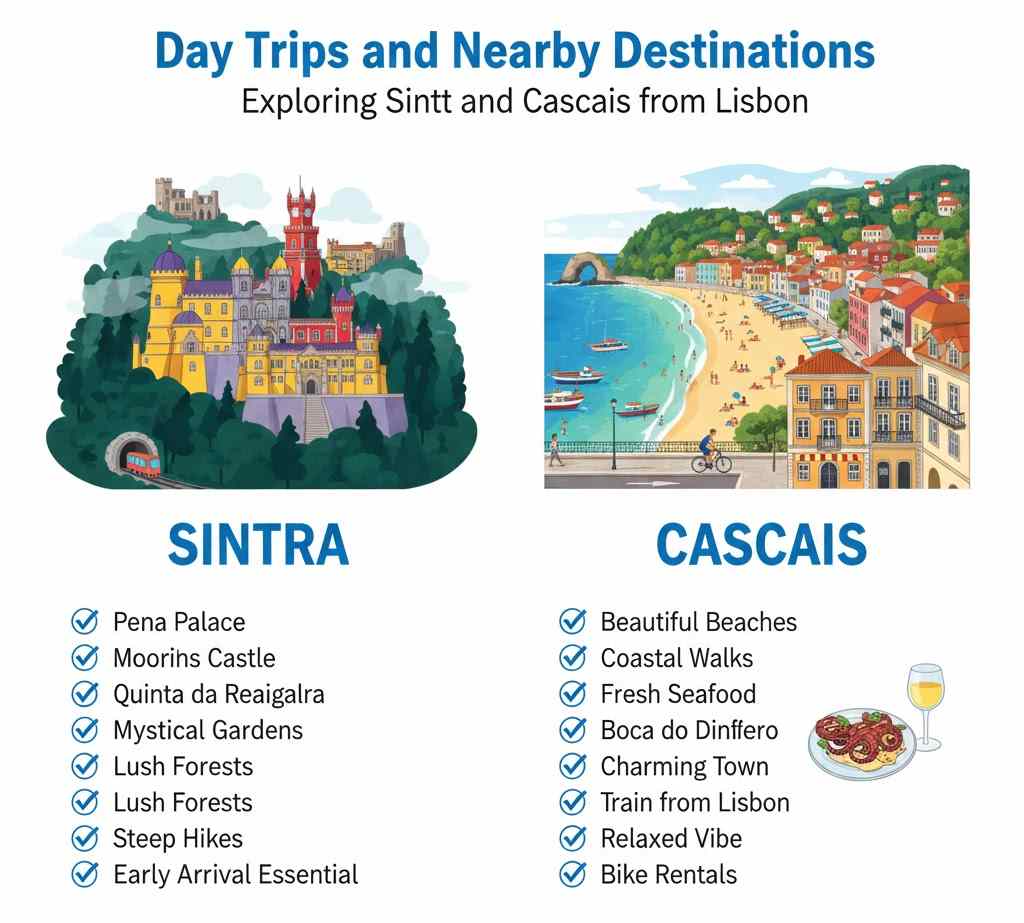
Sintra is a magical town nestled in the hills about 30 minutes from Lisbon by train. This UNESCO World Heritage Site is famous for its romantic 19th-century architecture, royal palaces, and mystical atmosphere. I took the train from Rossio Station early one morning and spent the entire day exploring Sintra.
Why Sintra deserves a full day:
- Multiple palaces and castles to visit
- Pena Palace with colourful fairy tale architecture
- Moorish Castle ruins with great views
- Quinta da Regaleira with mysterious gardens
- Palace of Sintra in the town centre
- Lush forested hills and hiking trails
- Cooler temperatures than Lisbon
- Often foggy, creating a mystical atmosphere
- Requires hopping between sites by bus
- Very hilly with steep walks
- Gets extremely crowded by midday
- Early arrival is essential to beat crowds
Pena Palace is the highlight of Sintra and one of the most photographed buildings in Portugal. This colourful palace sits atop a high hill overlooking the surrounding forest. The architecture is a mix of Gothic, Moorish, Renaissance, and Manueline styles painted in bright yellows, reds, and purples. It looks like something from a Disney movie brought to life.
I arrived at Pena Palace around 9 AM, and crowds were already forming. I bought my ticket online in advance, which saved significant time waiting in line. The palace interior is decorated with 19th-century furnishings showing how Portuguese royalty lived. But the real magic is the exterior and the surrounding park.
I spent over an hour walking around the palace, photographing it from different angles and exploring the terraces and towers. The views from the palace across the forested hills toward the Atlantic Ocean are breathtaking. In the distance, you can see all the way to Lisbon on clear days.
Cascais is a charming coastal town about 30 minutes from Lisbon by train. This former fishing village became a resort destination for Portuguese nobility and remains a popular beach getaway. I took the train from Cais do Sodré station, and the journey along the coast is beautiful in itself.
Cascais attractions:
- Beautiful beaches for swimming and sunbathing
- Charming historic town centre
- Fresh seafood restaurants along the marina
- Coastal walking paths with ocean views
- Boca do Inferno rock formation
- Citadel fortress area
- Museums, including art and sea
- Upscale shopping streets
- Relaxed resort town atmosphere
- Good surfing beaches nearby
- Easy train access from Lisbon
- Can combine with Estoril visit
I rented a bike in Cascais and rode along the coastal path toward the smaller towns of Estoril and São João do Estoril. The path follows the ocean with waves crashing against rocks on one side and cafes and restaurants on the other. The weather was perfect, sunny but with a cool ocean breeze, and I stopped multiple times to sit and watch the sea.
For lunch, I chose a seafood restaurant near the marina where I could watch fishing boats bobbing in the water. I ordered grilled octopus and a local white wine. The octopus was tender and perfectly seasoned, charred slightly on the outside while remaining juicy inside. Eating fresh seafood with ocean views while feeling the sun on my face, I thought about how these simple pleasures are what travel is really about.
Practical Tips for Visiting
Understanding some practical details will enhance your experience of Lisbon’s things to do and help you avoid common tourist mistakes I made during my first days in the city.
Getting around Lisbon:
- Walking is the primary transportation method
- Comfortable shoes are essential
- Seven hills mean lots of climbing
- Public transport is excellent and affordable
- Metro, trams, and buses are all integrated
- Reusable Viva Viagem card saves money
- Taxis and Uber are readily available
- Many streets are too steep for bikes
- Electric tuk-tuks are popular with tourists
- Elevators and funiculars help with hills
Lisbon is fundamentally a walking city built on steep hills. I made the mistake of wearing cute but impractical shoes on my first day and regretted it by noon when my feet were covered in blisters. The cobblestone streets are charming but unforgiving on feet and ankles. Bring your most comfortable walking shoes and save the stylish footwear for dinner.
The public transportation system is excellent and inexpensive. I bought a Viva Viagem card at the metro station, which is a reusable card you can load with money or day passes. A single journey costs around 1.50 euros, or you can buy unlimited day passes. The metro is modern and efficient, trams are iconic and atmospheric, and buses reach every neighbourhood.
Best times to visit:
- Spring, from March to May, is ideal weather
- Fall from September to October is also great
- Summer can be very hot and crowded
- Winter is mild but rainier than other seasons
- In August, many locals leave for vacation
- Shoulder seasons are best for avoiding crowds
- Book accommodations in advance for peak season
- Restaurants are busiest during Portuguese dinner time
- Major attractions are less crowded in the early morning
- On Sundays, many shops are closed traditionally
I visited in April, and the weather was perfect. Temperatures in the low to mid 70s Fahrenheit, sunny most days, with occasional spring showers. The jacaranda trees were blooming, filling streets with purple flowers. Tourist crowds were moderate, so I could visit attractions without fighting through masses of people, yet the city still felt vibrant and alive.
Portuguese people typically eat dinner late by American standards, often not sitting down until 9 or 10 PM. I adapted to this schedule, having a late lunch around 3 PM and then dinner around 9. This timing meant I was eating when restaurants were busy with locals rather than being the only diner at 6 PM.
Safety and practical concerns:
- Lisbon is very safe overall
- Pickpockets target crowded tourist areas
- Tram 28 and the viewpoints are particular targets
- Keep valuables secure and hidden
- Don’t leave bags unattended
- Scams are rare but exist
- People are generally honest and helpful
- Emergency services reliable
- Tap water is safe to drink
- English is widely spoken in tourist areas
- Learn basic Portuguese phrases
- Credit cards are accepted in most places
I felt safe walking around Lisbon at all hours, including late at night in neighbourhoods like Bairro Alto and Cais do Sodré. The city doesn’t have the threatening atmosphere that some European capitals can have after dark. People were out enjoying themselves, and I never experienced or witnessed any violence or serious problems.
Pickpocketing is the main concern, particularly on Tram 28 and at crowded viewpoints. I kept my phone and wallet in front pockets and remained aware of my surroundings in crowded places. Several travellers I met reported having items stolen, usually because their backpacks were unzipped or their phones were in easily accessible places.
Why Lisbon Stays With You
After spending weeks exploring things to do in Lisbon, I left the city feeling like I’d discovered something special that not enough people know about. Lisbon has the culture and history of other European capitals, but without the overwhelming crowds or aggressive tourist culture. It has beaches and beautiful weather like Mediterranean resorts, but with more authenticity and substance.
What makes Lisbon unforgettable:
- Perfect blend of history and modern life
- Stunning architecture around every corner
- Warm and welcoming local people
- Incredible food at reasonable prices
- Beautiful light and colors
- Soundtrack of fado and tram bells
- Seven hills provide constant views
- River adds openness and beauty
- Comfortable pace of life
- Easy to navigate despite hills
- Affordable compared to other capitals
- Authentic culture, not manufactured for tourists
The golden light in Lisbon is something photographers talk about, and experiencing it yourself reveals why. Something about the angle of the sun, the reflection off the river, and the colours of the buildings creates a warm, glowing quality to the daylight hours. Everything looks beautiful bathed in this light, from grand monuments to simple street scenes.
I found myself taking photos constantly, trying to capture the visual beauty surrounding me. The way light hits the tiles on building facades. The colours of laundry hanging in Alfama. The shadows of tram cables create geometric patterns on streets. The silhouette of the castle at sunset. Lisbon is endlessly photogenic.
But beyond the visual beauty, what stays with me most is the city’s feeling. The relaxed pace where people take time to enjoy life. The sounds of Portuguese have a soft, melodic quality. The taste of pastéis de nata and ginjinha. The emotional power of fado music. The kindness of strangers who helped when I was lost or confused.
One afternoon, I sat at a small cafe in Alfama, drinking espresso and eating a slice of tarte de amêndoa, watching the world go by. An elderly couple sat at the next table, holding hands and speaking quietly in Portuguese. A group of students laughed over something on a phone. A man passed by walking three small dogs. The light filtered through the awning, casting patterns on the cobblestones. In that moment, I felt completely content and present.
Things to do in Lisbon range from major tourist attractions to simple pleasures like sitting in cafes, getting lost in old neighbourhoods, and talking with locals. The best experiences often aren’t the ones you plan but the ones that happen when you slow down and let the city reveal itself to you.
If you’re considering visiting Lisbon, go. Don’t wait for the perfect time or the perfect travel companion. This city welcomes solo travellers, couples, families, and groups with equal warmth. It’s easy to navigate, affordable, safe, and filled with discoveries waiting around every corner.
Take the time to wander without a map. Eat at restaurants where you don’t recognise any of the menu items. Strike up conversations with locals. Watch the sunset from a different miradouro each evening. Riding the trams, ,would even be faster than walking. Listen to fado even if you don’t understand the words. Buy more pastéis de nata than you think you should eat.
Lisbon isn’t trying to impress you with flashy attractions or manufactured experiences. It’s simply being itself, a beautiful city with deep history, vibrant culture, and people who take time to enjoy life. And in being authentically itself, it becomes impossible not to love.