
Sit through almost any nursing conference talk on evidence-based practice, and you will hear the same number inside the first ninety seconds. Seventeen years. That is how long it supposedly takes for research to reach the bedside. The figure turns up in orientation slide decks, grant applications, DNP project proposals, and the opening paragraph of what feels like every EBP article published this decade.
It is worth knowing where that number came from, because the answer turns out to be a small, uncomfortable demonstration of the exact problem it is warning about.
Where The Number Actually Came From
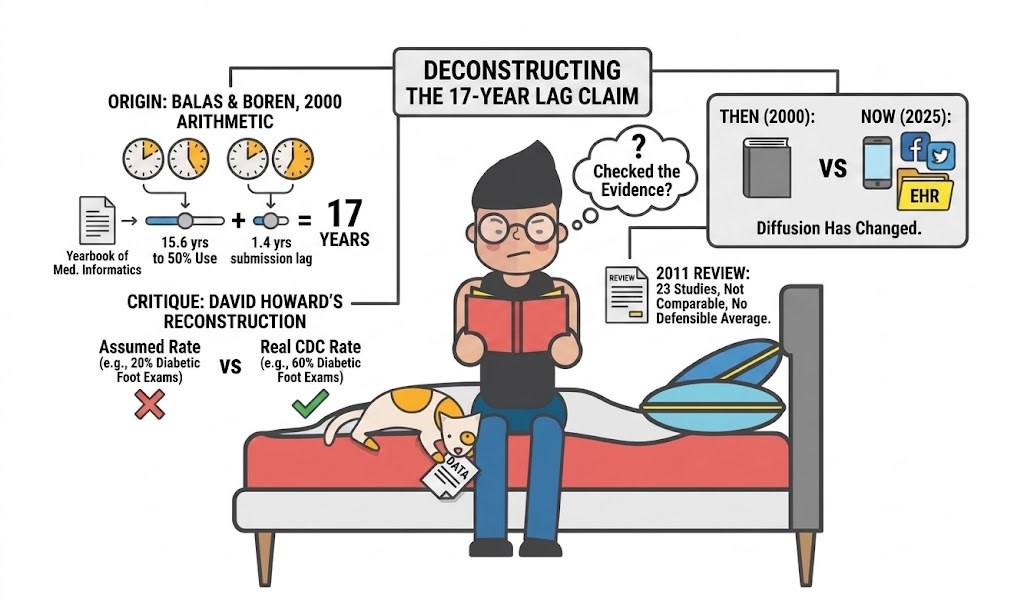
The seventeen years trace to a single 2000 paper by Balas and Boren in the Yearbook of Medical Informatics. Health economist David Howard went back and reconstructed the arithmetic. The authors picked nine mostly primary care services supported by randomized trials, compared publication dates against then-current utilization, and calculated that it took about 15.6 years for use to reach fifty percent. Add roughly 1.4 years for submission-to-publication lag, and you arrive at the familiar seventeen.
Howard also found problems with the inputs. Some utilization estimates were low and thinly referenced. The paper assumed only twenty percent of patients with diabetes received foot exams in 1998, when CDC figures put the real rate closer to sixty.
Then there is the 2011 review that made the number famous, titled, memorably, The answer is 17 years, what is the question. People cite it as confirmation. It is closer to the opposite. The authors found 23 papers attempting to quantify translation lag and concluded that few were comparable, because different studies measured different things at different points using different definitions. Their actual finding was that we do not have a defensible average.
A 2025 commentary in Frontiers in Health Services went further, examining how the figure gets used. Of 135 articles published in 2024 and early 2025 that cited Balas and Boren, more than half invoked it specifically for the seventeen-year claim. The authors point out something obvious once said aloud: the paper describes a world before smartphones, before social media, before near-universal electronic health records. Whatever diffusion looked like in 2000, it does not look like that now.
So a claim about the profession’s failure to check its evidence has circulated for twenty-five years, largely unchecked, and hardened into a fact. That is not a reason to dismiss it. It is a reason to notice how easily any of us accept a number that confirms something we already believe.
Gap Is Real Even If The Number Is Soft
None of this means practice changes arrive promptly. Anyone who has watched a unit keep doing something for years after the literature moved knows better.
What the shaky statistic should change is how the problem gets framed. The interesting question was never “how many years.” It is which changes stall, where they stall, and why. Those answers are local, and they are far more actionable than a national average that may not describe your hospital at all.
Why Evidence Stalls, Step By Step
A published study does not walk itself into a policy manual. Between a finding and a functioning protocol sit a series of separate failure points, each of which quietly kills plenty of good research.
Somebody has to encounter the study in the first place. Somebody has to appraise it and decide whether the study population resembles the patients on this unit, which is a real question when a trial was run in an academic medical center. Your hospital is a 90-bed rural facility. The change has to get through whoever controls order sets and EHR builds, and that queue is usually long. It has to compete with whatever regulatory or accreditation priority is consuming leadership attention this quarter. And it has to survive the six months of staff turnover that will happen during the rollout.
The barriers nurses themselves report are consistent and unglamorous. A survey of 1,015 registered nurses found that only about a third agreed their colleagues consistently used evidence-based practice, and the two most frequently named obstacles were lack of time and an organizational culture that did not support it. Notably, resistance from nurse leaders and managers ranked among the top five barriers, which is not where most EBP curricula point the finger.
It is worth saying plainly, because much of the literature on this topic reads as though nurses are the obstacle: most of the people being scolded for not implementing evidence are eleven hours into a twelve-hour shift with an assignment that was unsafe before lunch. Time is not a character flaw. Any implementation plan that assumes otherwise is going to fail, and it will fail in a way that gets blamed on the staff rather than the plan.
Part Where The Lag Is Protecting Patients
Here is the piece that rarely makes it into the standard version of this argument. Not every published finding should be implemented, and some of the practices that spread fastest are the ones the field later had to undo.
Intensive glycemic control in critical care is the textbook example: adopted widely on the strength of early trial results, then substantially walked back when larger studies found harm. It is not an isolated case. Practice reversal is a recognized phenomenon, and a protocol that diffuses in eighteen months rather than eighteen years is not automatically a win if the underlying evidence was a single-center trial that failed to replicate.
Undoing an established practice is also markedly harder than starting a new one. De-implementation of low-value care runs into sunk cost, professional identity, fear of liability, and the sheer gravitational pull of “we have always done it this way.” Awareness of what counts as low-value nursing care is itself thin. In one survey of nurses, only about a fifth of RNs were aware of the American Academy of Nursing’s Choosing Wisely recommendations at all.
The goal, then, is not speed. It is accuracy at a reasonable pace, which is a harder target and a less satisfying slogan.
Appraisal Skills Nobody Gets Taught
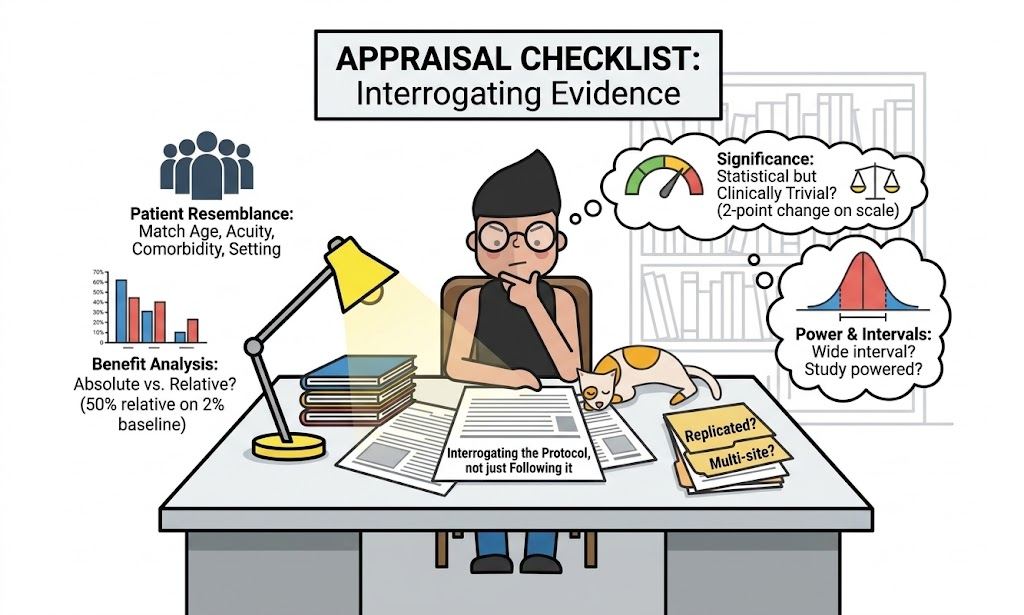
Most nursing programs teach students to follow evidence-based protocols. Far fewer teach them to interrogate one. Those are different skills, and the second does not develop automatically from years of competent bedside care.
Concretely, appraising a study means being able to ask:
- Does the study population actually resemble my patients in age, acuity, comorbidity, and setting?
- Is the reported benefit absolute or relative? A fifty percent relative reduction on a two percent baseline is one fewer event per hundred patients.
- Was the outcome something patients care about, or a surrogate marker that stands in for it?
- Is the result statistically significant but clinically trivial? A two-point change on a scale nobody notices is not a reason to rewrite a workflow.
- How wide is the confidence interval, and was the study powered to detect what it claims?
- Single-center or multi-site? Who funded it? Has anyone replicated it?
The structured question format most programs do teach, PICOT, is genuinely useful for framing what you are looking for, and the broader EBP process has been mapped out in detail. But framing a question is the easy half. Judging what comes back is where the real work sits.
This is also where the gap regenerates itself. If entry-level curricula do not build appraisal skills, every graduating cohort arrives without them, and the problem resets. That makes nursing faculty an unusually high-leverage point in the whole system, which is part of why experienced clinicians who move into teaching roles, often through DNP nursing education online programs, end up shaping whether the next generation can read a trial at all.
Where Doctoral Training Changes The Equation, And Where It Does Not
The practice doctorate exists largely to address this territory. The DNP is oriented toward applying and implementing evidence; the research-focused PhD is oriented toward generating it. Both are legitimate, and the distinction is not a hierarchy.
Worth knowing about the credential’s actual history: AACN’s 2004 position statement called for the DNP to become the entry degree for advanced practice nursing by 2015, a target that plainly was not met. Curricular expectations have also shifted. The 2021 competency-based Essentials superseded the 2006 DNP Essentials, and per AACN’s own fact sheet, the current version incorporates updates published in April 2026. If you are evaluating programs, ask directly how a given curriculum maps to the current competencies rather than assuming.
The honest caveats matter too. A doctorate does not confer institutional authority. Graduates still need a sponsor, protected time, and data access, and plenty of well-designed capstone projects die because none of those were arranged. DNP project quality varies considerably across programs. Some employers offer no pay differential at all. The degree is a set of tools and a measure of credibility, not a solution to an organization that does not want to change.
What it does reliably provide is structured training in implementation science and quality improvement methodology, which most nurses have genuinely never been taught end to end.
What Makes A Change Actually Stick
Projects that survive past the initial training session tend to share a specific set of features, and they are more concrete than “leadership buy-in.”
- A named owner with protected time. Not a committee, and not an executive signature. One person whose job description includes this, who is on the unit, and who notices in week three that night shift has invented a workaround.
- Baseline data collected before anything changes. Without it, you cannot distinguish improvement from wishful thinking. And prefer a run chart over a single before-and-after average, because a two-point comparison cannot tell your intervention apart from ordinary week-to-week variation.
- A design that makes the correct action the easy one. Default order sets, supply placement, a field that prepopulates. Anything relying purely on staff remembering a new step under load will decay, and the decay will be blamed on culture rather than design.
- A fast channel for friction. Frontline staff will find the problem in the first fortnight. If there is no low-effort way to report it, the workaround becomes permanent and invisible.
- An explicit answer to who owns this after the project ends. Sustainability is a plan, not a hope.
If you want a systematic way to think through the context you are working in, the Consolidated Framework for Implementation Research organizes the barriers and enablers most projects run into, and it is free to use.
Practical Cautions Before You Start
A few things that derail well-intentioned projects, and which nobody mentions until afterward:
Clarify early whether what you are doing is quality improvement or human subjects research. The line is genuinely blurry, particularly if you intend to publish or generalize your findings, and the determination belongs to your IRB rather than to you. Ask before you collect data, not after.
Do not build a change on one study. Look for a systematic review or synthesized guidance first, and be honest with yourself about what the evidence base actually supports.
Do not pilot something you have no mechanism to measure. An unevaluated pilot is just a change you made.
Keep the scope small. A project touching four units and three disciplines will fail one unit, one clearly defined metric, one defined period.
Watch for harm as deliberately as you watch for benefit. Interventions have side effects, including on workload, and a change that adds documentation burden will be quietly abandoned no matter how good the underlying evidence is.
Report what actually happened, including null and negative results. The profession’s evidence base is distorted by everyone only publishing the projects that worked.
Reframe Worth Keeping
Seventeen years is a soft number resting on nine services and a calculation from a quarter century ago. The underlying problem is not soft at all. Evidence really does sit unused, practices really do persist past their expiry date, and somebody on the ground has to be the one who notices.
That work is slower and less celebrated than the research that prompts it. It involves spreadsheets, meetings, and a fair amount of patience with colleagues who are not wrong to be skeptical. But every protocol currently preventing harm at a bedside somewhere started as a study that a person had to read carefully, argue for honestly, and then translate into something a tired nurse could actually do at three in the morning.
That translation is the job. It is worth doing carefully rather than quickly.
Disclaimer: This article is for general professional and educational information. It is not clinical guidance and should not be used to direct patient care. Nothing here substitutes for your organization’s policies, your IRB’s determinations, or applicable regulatory requirements. Program structures, accreditation status, admission requirements, and curricula vary by institution and change over time, so verify details directly with any school you are considering. Clinical examples are included to illustrate how evidence evolves and are not recommendations for or against any specific practice.