
A dessert station has a different kind of pull from the rest of an event.
Guests may walk past the seating plan, admire the flowers, and briefly notice the centrepieces. When they reach a table filled with small cakes, pastries, fruit tarts, or neatly arranged sweets, however, they often stop. They look more closely. They point something out to a friend. They take a photograph before choosing what to eat.
The desserts deserve some of the credit, but they are not working alone.
Under every tray, cake stand, vase, and handwritten label is a surface that controls how the whole display feels. A poorly fitted cloth can make an expensive arrangement look hurried. The right tablecloth can make simple homemade desserts feel as though they belong in the room.
This is why coordinated table linens should not be treated as something chosen after every other decision has been made. They are not background filler. They are the visual foundation of the dessert station.
A Dessert Table Is a Small Room Within the Room
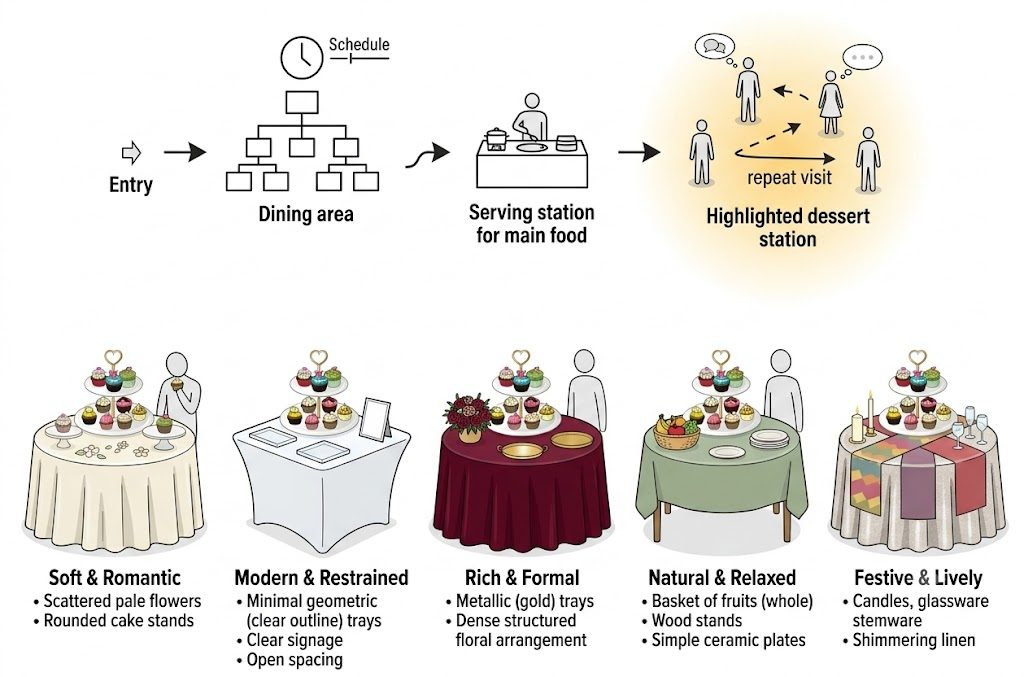
Event styling is often discussed as one large design problem, but guests do not experience a venue as a single picture. They experience it in sections.
They enter through one area, sit in another, move towards the food, and later gather near the desserts. Each section has its own purpose and emotional pace.
The dessert station is usually softer and more informal than the dining area. Dinner may follow a schedule, while dessert encourages wandering, conversation, and repeat visits. This makes the table feel less like a serving point and more like a small destination.
The tablecloth helps define that destination.
A floor-length linen gives the station visual weight and hides storage boxes, spare trays, cables, or table legs. A shorter cloth can make a daytime gathering feel lighter and less formal. A fitted cover creates a clean outline, while a loose fabric brings movement and softness.
The correct choice depends less on what is fashionable and more on what the station needs to communicate.
| Desired Feeling | Useful Linen Direction | Details That Support It |
|---|---|---|
| Soft and romantic | Matte ivory, blush, or muted champagne | Fine folds, pale flowers, rounded cake stands |
| Modern and restrained | Fitted white, stone, grey, or black | Clear signage, geometric trays, open spacing |
| Playful and bright | Pastel or colour-blocked cloths | Small sweets, illustrated labels, mixed stand heights |
| Rich and formal | Deep navy, burgundy, forest green, or velvet texture | Metallic trays, low lighting, structured florals |
| Natural and relaxed | Cotton-look, linen-look, sand, sage, or warm white | Wood stands, fruit, simple ceramics |
| Festive and lively | Subtle shimmer, layered runners, or patterned accents | Candles, glassware, seasonal decorations |
The tablecloth should establish the mood without trying to become the main attraction. If guests remember only the linen and not the desserts, the styling may be competing too hard.
Start With the Desserts, Not a Fabric Swatch
One common mistake is choosing a favourite linen before deciding how the desserts will be displayed.
A pale satin cloth may look beautiful in a sample photograph, but it may not suit a crowded table filled with chocolate cake, dark serving boards, paper labels, and tall floral arrangements. A patterned cloth may appear cheerful on its own but make small pastries difficult to see.
Before choosing fabric, list what will actually sit on the table.
Consider:
- The number of serving trays
- The colours of the desserts
- Whether stands are metal, glass, wood, ceramic, or acrylic
- The size of the main cake
- Whether flowers or greenery will be included
- How much signage is needed
- Whether staff will refresh the display
- Whether plates, napkins, and cutlery will share the same surface
This is where practical styling begins.
A table carrying twenty different items usually benefits from a quieter linen. A small station with one cake and a few trays may be able to handle more texture. A dessert display dominated by pale buttercream may need contrast underneath it, while bright fruit and coloured macarons often look better against a calm neutral base.
The cloth should help each item remain visible.
Why Coordination Does Not Mean Making Everything Identical
Large dessert displays often use more than one table. There may be a main cake table, a pastry table, a children’s sweets section, a drinks station, and a smaller surface for takeaway boxes.
Using unrelated linens on each table can make the area feel temporary, as though several displays were placed together at the last minute. Using the same cloth everywhere may solve that problem, but it can also flatten the design.
The stronger approach is repetition with controlled variation.
For example, all tables may use the same warm white base cloth while the cake table receives a pleated overlay. A deep green runner might appear on the main table and then return as a smaller accent beneath the drinks. The colour stays consistent, but the treatment changes according to importance.
This creates a visual hierarchy.
Guests can tell which table holds the centrepiece without needing a large sign. Their eyes move naturally from the main cake to the supporting treats. The arrangement feels connected without looking copied.
A Simple Coordination Formula
A useful formula for multiple tables is:
- One main base colour
- One supporting colour
- One texture used sparingly
- One repeated material, such as gold, wood, glass, or ceramic
More elements can be added, but every additional decision creates another opportunity for visual conflict.
A small number of repeated choices often looks more considered than a large number of impressive individual pieces.
Choosing Fabric Based on How the Event Will Actually Run
Fabric should not be selected only by appearance. Dessert stations are active work areas.
Platters are moved. Icing falls. Children touch the edge of the table. Coffee cups are set down beside serving plates. Staff reach across the cloth to replace desserts. Outdoors, wind can lift corners and blow lightweight decorations against food.
Different fabrics respond differently to this activity.
Polyester
Polyester is often chosen for busy events because it is generally durable, widely available, and easier to manage than more delicate materials. It can suit weddings, corporate functions, school celebrations, fundraising events, and large family gatherings.
Its appearance depends heavily on pressing, sizing, and colour. A clean, properly fitted polyester cloth can look far more polished than an expensive fabric that has been stored or installed poorly.
Satin
Satin reflects light and can create a soft sense of movement. It works best when the room has controlled lighting and the rest of the display is fairly restrained.
Because reflective fabric draws attention to folds, seams, and wrinkles, it needs careful preparation. Bright venue lighting can also make shiny cloth appear more dramatic than expected.
Velvet
Velvet gives depth to winter events, formal dinners, evening receptions, and displays using rich colours. It can make pale cakes and metallic stands look especially clear.
It is also visually heavy. Covering every nearby surface in velvet may make the dessert area feel dense. It is often more effective as an accent than as the only material in sight.
Cotton and Linen-Look Fabrics
Natural-looking materials suit garden parties, daytime weddings, relaxed birthdays, and rustic settings. Their slightly irregular surface can make an arrangement feel warmer and less staged.
True natural fibres may crease quickly, so planners should consider how the linen will be transported, stored, and pressed. When comparing products, review fiber information and manufacturer instructions rather than judging by a product photograph alone. The Federal Trade Commission’s textile and apparel guidance explains the importance of fiber-content, origin, and care information when evaluating textile products.
Spandex and Fitted Covers
Fitted covers produce a sharp outline and stay close to the table. They are useful for modern displays, trade events, branded functions, and locations where loose fabric could be inconvenient.
Their clean appearance makes the table shape more noticeable, so damaged legs, uneven floors, or poor sizing can become obvious. Correct measurements matter.
Buying in Quantity Should Improve Control, Not Create Excess
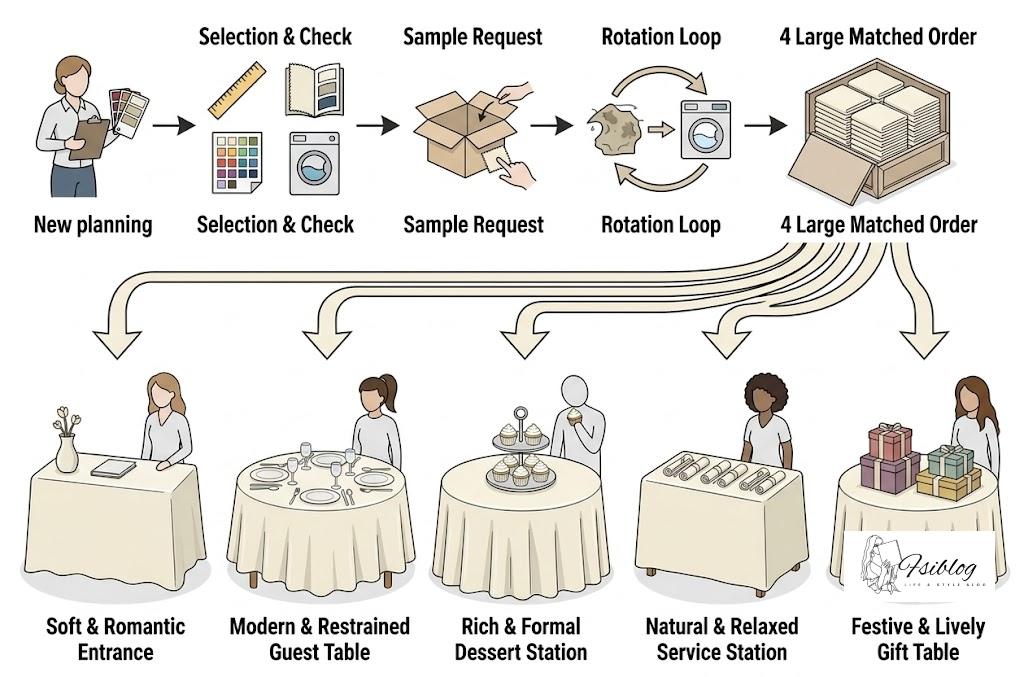
Ordering linens in quantity is most useful when it reduces variation.
A planner working across several events may need the same shade, fabric weight, dimensions, and finish to appear repeatedly. A venue may want reliable cloths that can be rotated while other sets are being cleaned. A large celebration may need matching coverage for the dessert area, guest tables, gift table, entrance table, and service stations.
For someone looking to buy tablecloths wholesale, the real advantage is not simply receiving more pieces. It is gaining control over consistency.
Before placing a larger order, confirm:
- Exact table measurements
- Finished cloth dimensions
- Intended drop length
- Fabric composition
- Washing or professional-cleaning instructions
- Colour consistency between batches
- Seam placement
- Edge finish
- Opacity under strong lighting
- Replacement availability
- Storage requirements
Requesting a sample can prevent an expensive mistake. Colours shown on screens may change under daylight, warm indoor lighting, photography flashes, or coloured uplighting.
The same applies to white. Bright white, soft white, ivory, cream, and champagne are not interchangeable once they are placed beside flowers, plates, and cake icing.
Measure the Drop Before Falling in Love With the Look
A tablecloth’s “drop” is the distance from the tabletop edge to the bottom of the fabric. This measurement changes both the appearance and the safety of the station.
A floor-length drop looks formal and hides the table structure. A medium drop feels more relaxed. A fitted cover creates little or no loose drop.
Problems begin when this decision is left to guesswork.
A cloth that is too short may expose storage boxes or table legs. One that pools heavily on the floor can collect dirt, interfere with staff, or become a trip concern. A cloth that barely reaches the ground may look uneven if the floor slopes or the table legs are not adjusted correctly.
Measure the table after it has been placed in its final position. Do not assume that every hired table described as the same size is perfectly identical.
For round cloths, check the table diameter and height. For rectangular cloths, check length, width, and height. When tables are joined, measure the full combined surface rather than ordering separate covers without considering the visible meeting point.
Colour Should Connect the Event, Not Copy the Cake
Matching the cloth exactly to the icing is rarely necessary.
In fact, placing a white cake against a white wall on a white table can remove the very contrast needed to appreciate its shape. Similarly, placing pink desserts on a pink cloth beside pink flowers can cause separate details to merge.
A better question is: what colour helps the desserts read clearly while still belonging to the wider event?
Use Contrast With Restraint
Contrast does not always mean choosing opposites. A soft cream cake may stand out beautifully against muted sage, dusty blue, stone, or pale taupe.
Dark cloths create strong contrast but also reveal crumbs, sugar, and dust. Light cloths feel fresh but may show chocolate, fruit, coffee, or icing stains more quickly.
Test Colour Under Event Lighting
A fabric viewed beside a window at noon may look completely different in a ballroom after sunset. Warm bulbs can make white appear cream. Purple uplighting may alter grey. Flash photography can exaggerate shine.
Place a sample beside the serving stands, plates, and at least one representative dessert. Photograph the setup in lighting close to the planned event conditions.
A ten-minute test can reveal more than hours spent comparing colour names online.
Texture Is Most Effective When Guests Notice the Display First
Texture adds interest, but it also creates visual noise.
A sequined overlay, crushed velvet cloth, pleated skirt, lace layer, or heavily woven surface can each work well. Using several together is much harder.
The eye needs somewhere to rest.
If the desserts contain delicate piping, detailed toppings, printed cookies, or colourful decorations, the base beneath them should usually be quieter. If the food is simple and monochrome, texture can give the station more presence.
One textured linen is often enough to distinguish the main table. Supporting tables can repeat its colour in a smoother material.
This keeps the display connected while protecting the main focal point.
Plan for Real Guests, Not Only Photographs
A dessert station can look flawless before the doors open and become difficult to use once guests arrive.
Good design considers reaching, queuing, serving, and movement.
Avoid placing every popular item in the centre, where guests must lean over other desserts. Keep plates and napkins near the natural starting point. Place serving tools where they are easy to return without crossing another tray.
Do not let long runners, boxes, stands, or decorations narrow the route around the table. Businesses and venues open to the public should consider physical access rather than treating it as an optional styling concern. The U.S. Department of Justice provides practical information about accessibility responsibilities for businesses open to the public, including the need to address barriers that can prevent people using mobility devices from reaching services.
Even at a private event, the principle is useful. Guests should not have to stretch dangerously, squeeze through a decorative gap, or ask someone else to reach every item for them.
Small Accessibility Improvements
- Keep at least part of the station at an easy serving height
- Avoid surrounding the table with floor decorations
- Leave a clear approach route
- Use labels that are easy to read
- Provide stable serving tools
- Keep essential items away from the deepest part of the table
- Offer assistance without making guests feel singled out
- Avoid low decorations that are difficult to detect while walking
A beautiful station should welcome people into the experience rather than make them work around the styling.
Food Safety Belongs in the Design Plan
Dessert styling cannot be separated from food handling.
Many baked goods can remain at room temperature for a reasonable serving period. Still, desserts containing cream, custard, soft cheese, mousse, cut fruit, or other perishable ingredients may need closer temperature control.
The FDA’s guidance for serving safe buffets recommends keeping cold foods chilled and using smaller serving dishes that can be replaced rather than leaving a large quantity out for an extended period.
The USDA’s buffet safety advice also advises tracking how long food has been sitting out and replacing smaller platters as needed. Its general guidance uses a two-hour limit for many perishable foods, reduced to one hour when temperatures are above 90°F.
This affects the linen plan.
If chilled trays, bowls of ice, refrigerated displays, or frequent platter changes are required, leave room for them from the beginning. Do not build such a crowded design that staff cannot safely remove and replace food.
Condensation should also be considered. Cold serving dishes can leave damp circles on some fabrics. A discreet protective layer under the tray can preserve the appearance without changing the visible design.
Prepare for Spills Before the First Guest Arrives
Chocolate, berry fillings, coffee, icing, food colouring, candle wax, and oily pastry crumbs all behave differently on fabric.
Trying to clean a stain without knowing the material can set it permanently or damage the finish. Keep the product’s care instructions with the event supplies and label storage bags so cloths are not separated from their washing information.
The American Cleaning Institute’s stain-removal guide recommends checking care instructions and treating stains appropriately rather than relying on one method for every fabric.
A small event linen kit may include:
- Clean absorbent white cloths
- Paper towels
- Spare napkins
- Fabric-safe stain treatment
- Disposable gloves
- A bag for wet or heavily soiled linens
- A duplicate cloth for the main table
- Clips or fasteners
- A lint roller
- A handheld steamer, where permitted
Do not rub a fresh spill aggressively. Blotting and following the fabric’s care guidance is usually safer than spreading the mark across a larger area.
Outdoor Dessert Stations Need a Different Plan
An outdoor table may look effortless in photographs, but it is exposed to heat, wind, dust, insects, uneven ground, sudden rain, and changing light.
Lightweight cloths may lift at the corners. Long drops may brush against wet grass. Direct sunlight can soften icing, warm perishable fillings, and alter how linen colours appear. A display positioned beautifully in the morning may sit in harsh sun by the time dessert is served.
Secure the linen using methods that remain hidden from guests. Clips, fitted underlayers, discreet weights, and careful table placement can help, but nothing should be attached in a way that could fall into food or create a sharp edge.
Weather planning also needs to go beyond checking whether rain is likely. The National Weather Service recommends that organisers of outdoor activities establish and follow a lightning safety plan for outdoor events, including deciding who monitors conditions and where people will move if a storm approaches.
A linen can be replaced. Guest safety cannot.
Candles Need Space, Stability, and Permission
Candles can make desserts look warm and inviting, particularly at evening receptions. They also introduce an open flame beside fabric, paper labels, flowers, and guests reaching across the table.
Before using them, confirm the venue’s rules. Many venues restrict open flames or require enclosed holders.
The U.S. Fire Administration’s candle fire-safety guidance advises using sturdy holders and keeping candles away from items that can burn.
On a dessert station:
- Keep flames away from loose fabric
- Do not place candles where sleeves may pass over them
- Use stable holders that cannot tip easily
- Avoid placing candles behind tall serving stands
- Keep flames away from dried flowers and paper signs
- Never leave burning candles unattended
- Consider flameless candles where open flames are unsuitable
The safest decoration is one that still looks good when the table is busy.
Reusable Linens Need a Life Beyond One Photograph
Buying coordinated cloths can reduce the need to source new linens for every event, but only when the pieces are selected for repeated use.
Highly specific colours, unusual shapes, or delicate finishes may work for one celebration and then remain unused. Neutral base sets with interchangeable runners or overlays are often easier to reuse.
The U.S. Environmental Protection Agency’s materials management hierarchy places source reduction and reuse ahead of less preferred waste-management options.
For event linens, practical reuse means:
- Buying dimensions that fit common table sizes
- Choosing durable fabrics where appropriate
- Repairing loose hems before they worsen
- Storing cloths clean and fully dry
- Rotating sets to reduce uneven wear
- Using separate overlays to refresh neutral bases
- Donating or reselling pieces that no longer suit the inventory
- Keeping records of colour names and purchase batches
A reusable linen is only useful when they can be found, identified, cleaned, and installed without guesswork.
Setup Should Be Judged From Several Distances
A dessert station is often styled from arm’s length because that is where the work happens. Guests first see it from much farther away.
Stand at the room entrance and look at the table. Does it appear balanced? Is the cake visible? Does one cloth hang lower than the others? Do the colours connect with the rest of the venue?
Then move closer.
At a few feet away, check whether labels can be read and whether the height changes feel natural. Finally, stand where a guest will serve themselves. Check that trays are reachable, tools are obvious, and decorations do not interfere.
Take photographs from all three distances.
Cameras reveal folds, exposed table legs, crooked runners, visible boxes, and awkward gaps that the eye may ignore during setup. They also show whether reflective fabric is creating glare.
A Final Styling Check Before Guests Arrive
Use one final walk-through after the desserts have been placed.
| Check | What to Look For |
|---|---|
| Linen alignment | Straight edges, even drops, hidden clips |
| Fabric condition | No visible creases, stains, lint, or damp marks |
| Table stability | No rocking, uneven joins, or weak risers |
| Food access | Serving tools and plates are easy to reach |
| Visual balance | No crowded corner or empty unexplained gap |
| Safety | Clear walkways, stable stands, controlled candles |
| Staff access | Trays can be replaced without dismantling the display |
| Photography | Main features remain visible from likely camera angles |
| Backup plan | Spare linen and cleaning supplies are nearby |
The aim is not to create a table that remains untouched. A dessert station is meant to be used.
The best version will still look welcoming after guests have taken several plates, moved a serving tool, dropped a few crumbs, and returned for another choice.
Tablecloth Is Part of the Hospitality
A coordinated dessert station communicates care before anyone tastes the food.
It tells guests that the event was planned as a complete experience rather than a collection of separate purchases. It gives simple desserts a sense of place, helps elaborate cakes remain visible, and turns several tables into one clear story.
The most effective linen may not be the most expensive or dramatic. It is the one that fits correctly, supports the food, survives real use, connects with the room, and quietly makes the entire display feel as though it belongs there.
Guests may not leave discussing the fabric by name. They will remember that the dessert area felt inviting, calm, generous, and worth gathering around.
That quiet memory is the real work happening underneath the cake stands.