Apothecary products support wellness routines, and they also inspire practical home, bath, and beauty creations. Since ingredient options vary, understanding common categories helps in choosing items that suit specific uses. Here are a few popular apothecary products:
1. Essential Oils
Essential oils are widely used apothecary products that provide natural fragrances for everyday lifestyle practices. Single-note oils deliver consistent aromas and make blending and formulation straightforward, supporting routine aromatherapy use. Pre-formulated apothecary blends combine multiple oils into fixed, complex profiles designed to balance and harmonize various scents in a single bottle. Products are available in standard sizes for personal daily use and larger formats for commercial or high-volume needs.
2. Fragrance Oils
Fragrance oils are apothecary products used to expand scent options for soaps, candles, and other personal-care formulations. Product labeling typically indicates the fragrance family, which helps buyers select scents suited to specific apothecary projects. Crisp citrus fragrances are commonly used and often mimic clean, fresh profiles associated with dish soaps, laundry detergents, and household cleaning products. “Clean” scent categories include linen and spring-fresh profiles that are also widely used in laundry products and room sprays.
Traditional apothecary-inspired scents, including herbs, woods, and fresh florals, add a wider variety to fragrance supply collections. Some fragrance oils intended for perfumery are supplied in pre-diluted form to simplify blending and application. Recommended usage rates differ by end use, and selecting the appropriate fragrance level helps maintain consistent scent strength in finished soaps and candles. Detailed labeling also indicates performance characteristics, including how well specific fragrance oils integrate into soap bases and candle wax.
3. Soaps and Candles
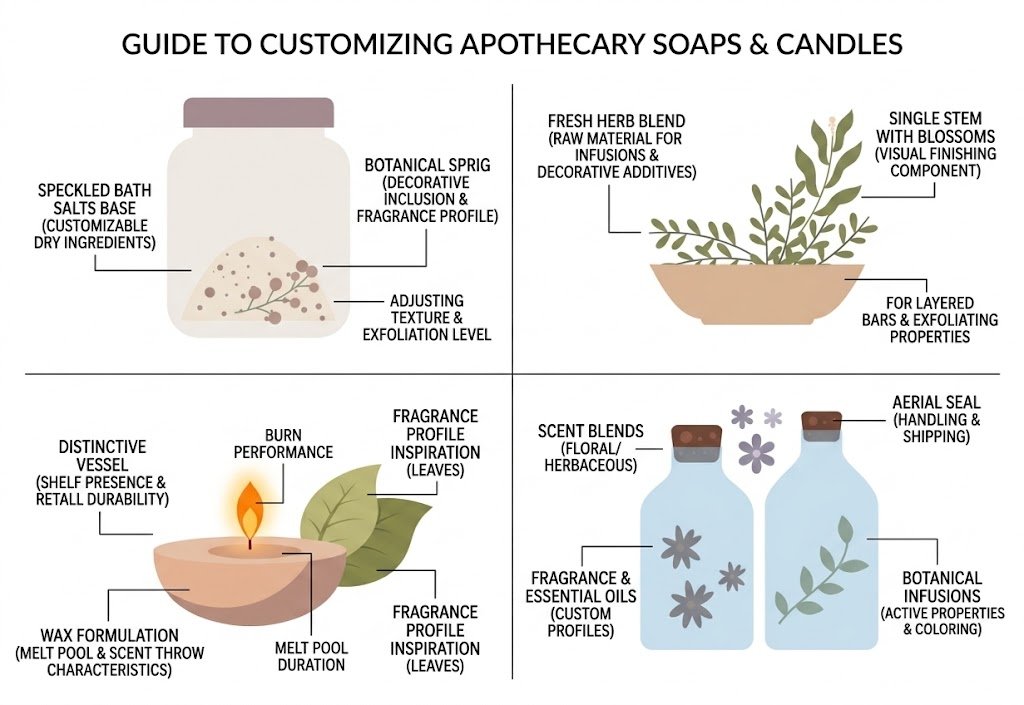
Handmade soaps are often customized with fragrances, botanicals, and decorative layering techniques. These variations allow a single product to combine functional cleansing properties with a more decorative, skincare-oriented presentation. Transparent soap gels can hold embedded additives, while surface decorations and finishing techniques differentiate products visually.
Bars are further modified with botanicals, exfoliants, or small inclusions that change both appearance and tactile qualities. Adjusting ingredients and fragrance profiles in apothecary soaps allows households to select bars that better match specific grooming routines. Buyers commonly evaluate soap listings based on details such as bar size, texture, and intended function. Soap bases also differ in opacity and firmness, and those material properties directly affect the final appearance of the finished bar.
Apothecary supply retailers also offer candles and candle-making materials in multiple formats, including a range of vessels, waxes, and finishing components. Some makers choose simple, uniform candle containers for testing or small production runs; others select distinctive vessels to create a stronger shelf presence. The selection of jars or glass containers affects both product durability and handling during shipping and retail stocking. Candle lines organized by color or theme can produce different visual effects depending on shelf arrangement and display context. Wicks, dyes, and fragrance additives further shape the appearance and presentation of the finished candle. Wax formulation influences burn characteristics such as melt pool and scent throw.
4. Body Care Products
Products such as lotions, body mists, and body oils form a base layer for daily self-care and skincare routines. Packaging variations help differentiate targeted hand lotions from products designed for full-body application. Salves in larger containers support frequent use and can address broader moisturizing needs across multiple areas of the skin. Lip balms are typically packaged in compact formats intended for portable, on-the-go application. Distinct packaging systems also help separate bath products from everyday personal care items; this supports a more organized routine. Clear labeling and functional containers make it easier to distinguish between daily-use products and items reserved for occasional bath or treatment use. Storage conditions, such as exposure to heat or light, also affect product stability and shelf life over time. Wholesale vendors often supply these products in bulk formats, supporting retail inventory needs and larger-scale production workflows.
Get Quality Apothecary Products Today
Whether you are building a personal wellness routine or sourcing materials for a growing business, selecting high-quality products helps verify consistency across every project. Essential oils, fragrance oils, soaps, candles, and body care supplies each contribute to organized self-care routines and customized product creation. Wholesale apothecary vendors provide a broad selection of base items, as well as ingredients to customize your creations further. Work with a reputable bulk supplier today.
Disclaimer
This article is for general informational purposes only and is not intended to provide medical, cosmetic formulation, regulatory, or safety advice. Apothecary products such as essential oils, fragrance oils, soaps, candles, lotions, salves, body oils, and lip balms should be used according to product labels, supplier instructions, and applicable safety guidelines.
Some ingredients may cause skin irritation, allergic reactions, scent sensitivity, or other adverse effects in certain individuals. Essential oils and fragrance oils should not be applied directly to the skin unless they are properly diluted and intended for topical use. Products used in candles, soaps, and body care formulations should be selected according to their recommended usage rates and intended application.
Businesses that make or sell apothecary products should review applicable labeling, ingredient, cosmetic, candle safety, and consumer product regulations before distribution. Consumers with allergies, pregnancy-related concerns, respiratory conditions, sensitive skin, or medical conditions should speak with a qualified healthcare professional before using new aromatherapy, skincare, or body care products.
References
- U.S. Food and Drug Administration. (2025). FDA Authority Over Cosmetics: How Cosmetics Are Not FDA-Approved, but Are FDA-Regulated. U.S. Food and Drug Administration. Last updated November 18, 2025. Accessed May 31, 2026.
- U.S. Food and Drug Administration. (2022). Fragrances in Cosmetics. U.S. Food and Drug Administration. Last updated February 28, 2022. Accessed May 31, 2026.
- U.S. Food and Drug Administration. (2023). Aromatherapy. U.S. Food and Drug Administration. Last updated September 8, 2023. Accessed May 31, 2026.
- U.S. Food and Drug Administration. (2024). Is It a Cosmetic, a Drug, or Both? Or Is It Soap? U.S. Food and Drug Administration. Last updated September 11, 2024. Accessed May 31, 2026.
- U.S. Food and Drug Administration. (2022). Soaps & Lotions. U.S. Food and Drug Administration. Last updated February 25, 2022. Accessed May 31, 2026.
- U.S. Food and Drug Administration. (2025). Summary of Cosmetics Labeling Requirements. U.S. Food and Drug Administration. Last updated November 18, 2025. Accessed May 31, 2026.
- National Center for Complementary and Integrative Health. (n.d.). Aromatherapy. National Institutes of Health, U.S. Department of Health and Human Services. Accessed May 31, 2026.
- National Cancer Institute. (2023). Aromatherapy With Essential Oils. PDQ Cancer Information Summary. National Cancer Institute, National Institutes of Health. Last updated September 11, 2023. Accessed May 31, 2026.
- International Fragrance Association. (2023). Notification of the 51st Amendment to the IFRA Standards. International Fragrance Association. Published July 5, 2023. Accessed May 31, 2026.
- International Fragrance Association. (n.d.). IFRA Standards: Standards Documentation. International Fragrance Association. Accessed May 31, 2026.